
 Japanese
 English
 Arabic
 French
 Italian
 German
 Spanish (Spain)
 Thai
 Turkish
 Indonesian
 Vietnamese
 Polish
 Portuguese
 Malay
 Swedish
 Spanish (Mexico)
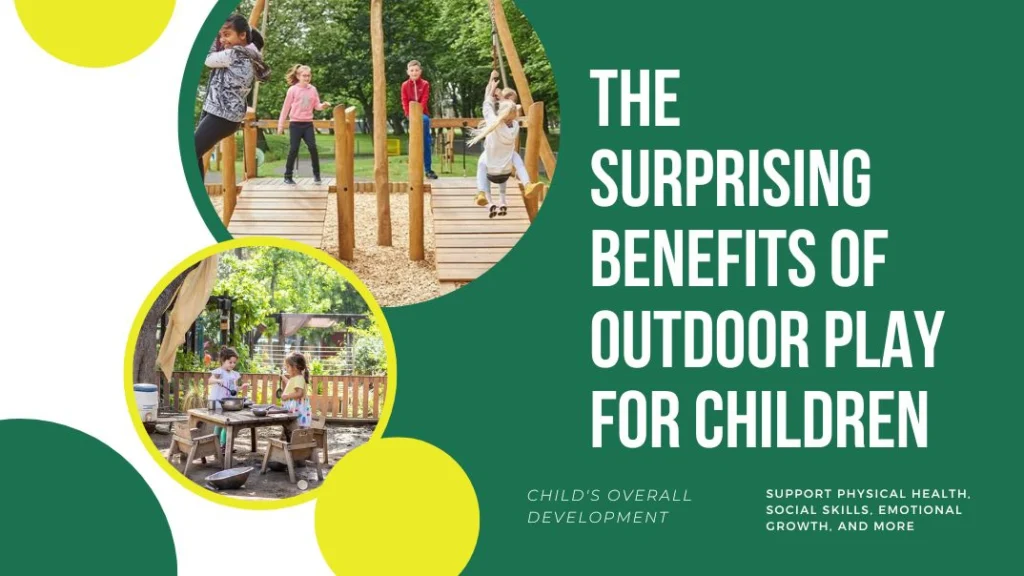
The benefits of outdoor play become easier to see when you look beyond a break from the classroom. A child testing where water will flow, negotiating a game, or trying a new movement is using play to learn. Your outdoor environment can make those experiences part of an ordinary day.
Below, you can explore seven benefits for children’s development, how to adjust your support for different ages, and what helps turn time outside into meaningful play.
The Main Benefits Of Outdoor Play
Different kinds of play offer different opportunities. You will see more of these benefits when children can choose between moving, investigating, making things, and spending time with others, rather than following the same activity throughout a session.
Physical Activity And Motor Skills
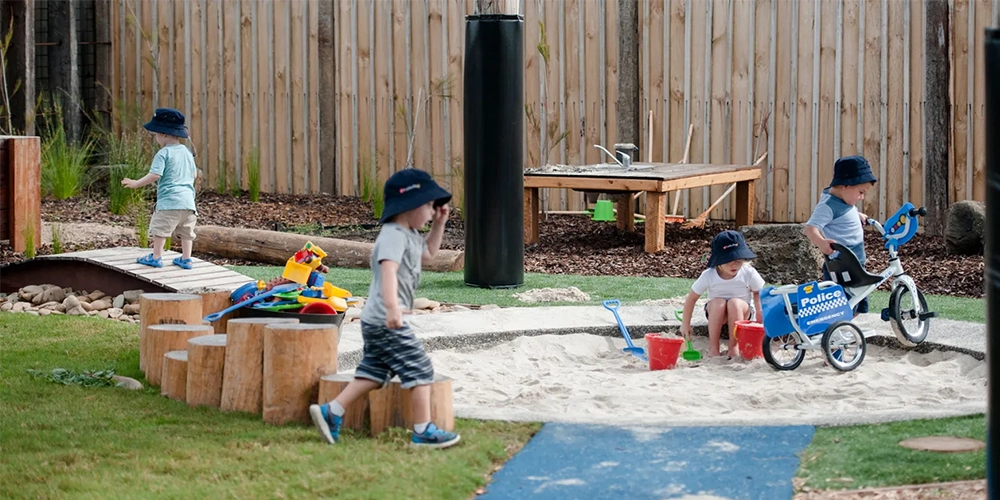
Outdoor play gives children room to practice coordination, balance, and motor skills. Running, jumping, and climbing give children ways to use large muscle groups, while changes in direction and pace demand control. A stopping game, for example, involves judging momentum as well as moving quickly.
You can also notice smaller movements within an outdoor activity: gripping a tool, turning a handle, or controlling a pour. These actions give hands and fingers useful practice without separating physical development from play.
あ systematic review of early childhood education settings found that outdoor time was associated with more physical activity. Going outside alone does not tell you how active a session will be; watch for opportunities to move and for long stretches of waiting. For a closer look at movement choices, explore gross motor skills in early childhood.
Scientific Exploration And Problem-Solving
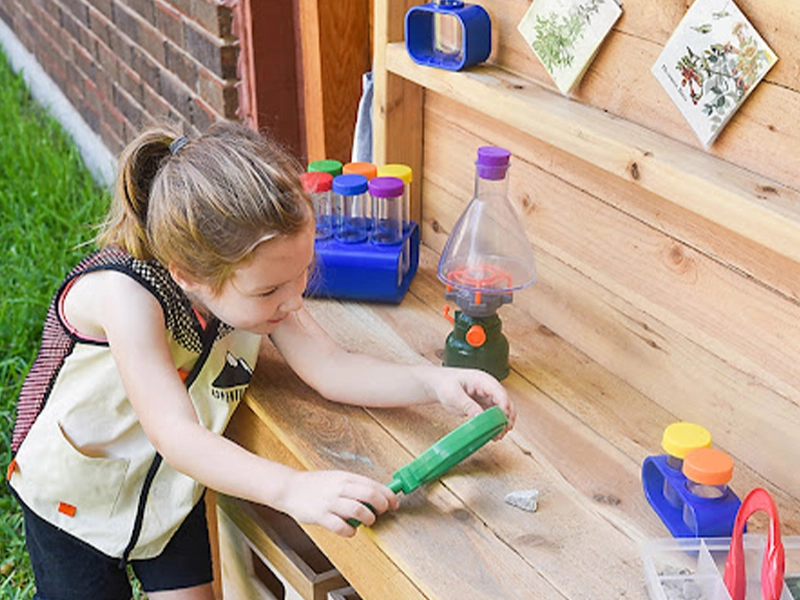
Outside, you have changing conditions that invite questions. Insects appear in one patch of ground but not another. A shadow moves. Water disappears into soil but collects on a hard surface. These differences give children something real to observe and compare.
At a 砂と水のテーブル, you can introduce a short channel and ask what will happen when one end is raised. Help children make a prediction, try it, and compare the result with the prediction. A drawing of the result gives you a starting point for the next investigation.
Communication And Cooperation
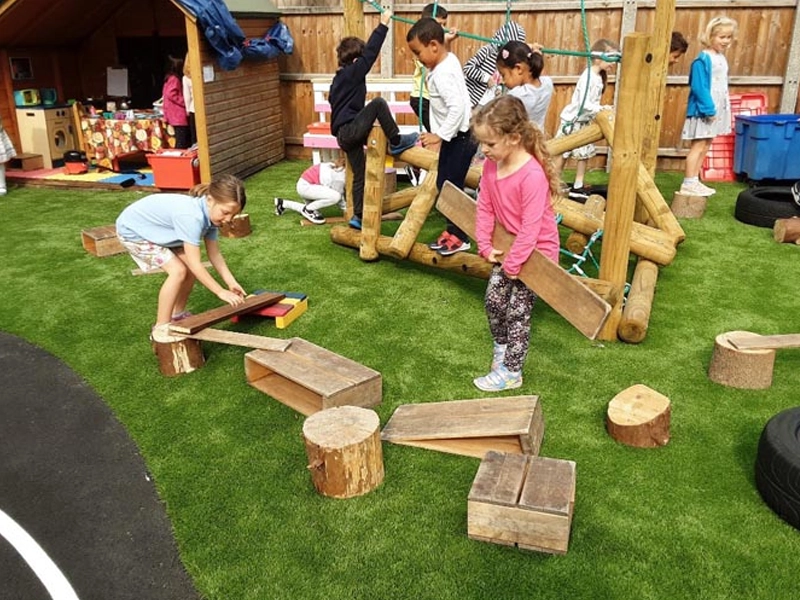
Outdoor play also helps children develop communication skills. A shared game creates a reason to explain an idea, listen to a different suggestion, and agree on what happens next. Building a fort together, for instance, involves deciding who will hold, carry, or connect each part.
Sharing and taking turns become part of getting something done together. You can hear the difference between simply asking for an object and explaining why it is needed. A disagreement can become a chance to practice making a request or proposing another arrangement.
Your support still matters. Offer words when a child cannot enter a game, and step in when exclusion or conflict makes participation difficult. Being outside does not automatically create cooperation; shared play gives you a setting in which to support it.
Imagination And Creative Expression
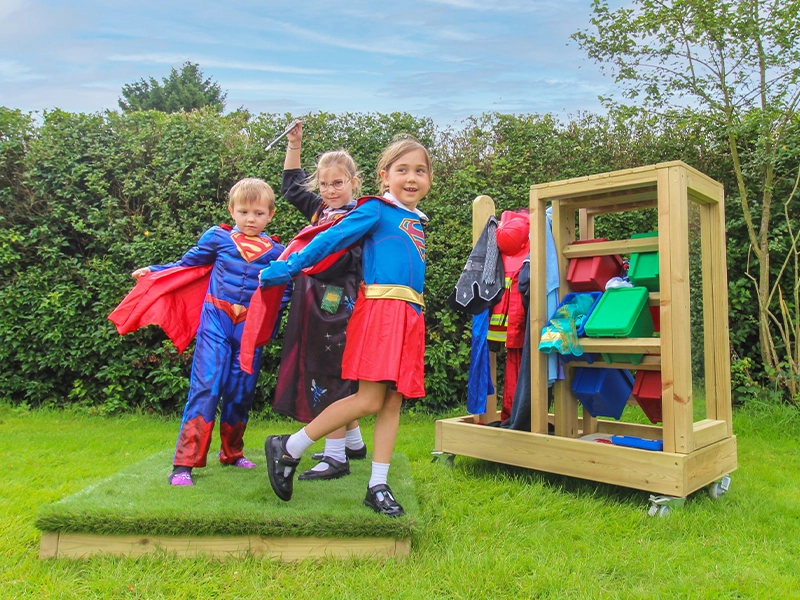
An outdoor space does not need a fixed story. An outdoor playhouse can become a café, a clinic, or a family home as children change the story. Chalk marks can extend that setting into an imaginary town. You leave room for original ideas when the same space and materials can take on different meanings.
Simple loose parts can become props for those stories. Choose pieces for the children’s age and abilities, with particular care around small items and mouthing. Creative freedom still needs appropriate material selection and supervision.
Confidence Through Manageable Challenges
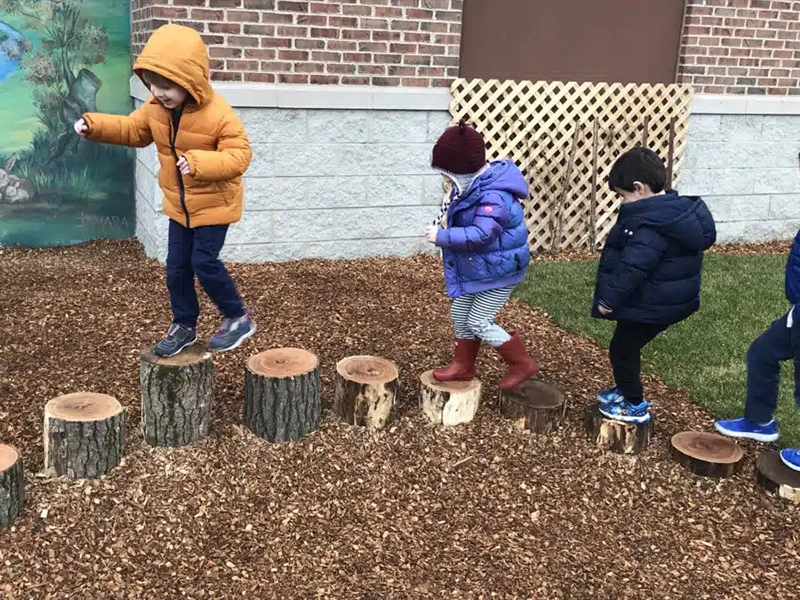
A challenge feels different when a child chooses to attempt it. You might observe hesitation before stepping across a low balance feature, followed by a pause, another approach, and a successful crossing. Progress can also mean deciding that a task is not manageable yet and choosing an easier version.
You support confidence by allowing that judgment to develop. Describe the action rather than urging a child to go higher or faster. Repeating a familiar challenge can be useful even when another child has already moved on.
その Canadian Paediatric Society distinguishes manageable risks from hazards. A challenge a child can recognize is different from a hidden danger, such as damaged equipment. Remove hazards, maintain supervision, and follow applicable safety requirements; never use the value of challenge as a reason to overlook those responsibilities.
Emotional Well-Being And A Change Of Pace
Outdoor play can offer relief from an intense indoor routine. You can give children a choice between energetic activity and a quieter experience, such as listening to leaves or sitting beside a planting area. A change of pace gives you another way to respond when a child needs a pause.
その American Academy of Pediatrics’ guidance on playing outside describes potential benefits for mood and stress. That does not mean every outdoor environment is calming. Noise, crowding, or unfamiliar textures can feel overwhelming, so notice individual responses rather than assuming one activity will suit everyone.
A quiet option should remain part of the play space, not a punishment or a place out of your view. Offer time to settle and a supported return when the child is ready. Outdoor play complements everyday emotional support; it is not a treatment for a mental health condition.
Connection With Nature And Care For Living Things
Regular contact with living things gives care a practical meaning. With suitable children’s gardening tools and planters, you can make watering and tending a plant part of the outdoor routine. Leaving an insect’s shelter undisturbed offers a different kind of responsibility: recognizing when care means not interfering.
Keep the focus on the relationship, not only on naming plants or animals. Returning to the same place allows children to notice what needs attention and what should be left alone. When a plant wilts, for example, you can discuss how to care for it without treating the discovery as a failed activity.
You do not need to turn every encounter into a lesson. Time to watch, wonder, and become familiar with the surroundings can be valuable in its own right.

Does Outdoor Play Improve Sleep?
Outdoor play can be part of an active daily routine, but you should not promise better or longer sleep simply because children spend more time outside. A systematic review published in the Journal of Sport and Health Science found mixed results for sleep duration and rated the sleep evidence as very low certainty.
Keep rest and sleep arrangements appropriate to each child’s needs. An energetic outdoor session is not a reason to shorten a nap or assume that bedtime difficulties will resolve.
How Your Support Changes With Age
You can keep the same outdoor environment useful as children grow by changing how much choice, explanation, and adult help you offer. Use the following distinctions as planning prompts, not milestones that every child must meet on schedule.
| ステージ | How To Introduce Play | How To Adjust Your Support |
|---|---|---|
| 幼児 | Introduce unfamiliar materials one at a time and demonstrate how to handle them. | Use short, one-step cues and respond to gestures as well as words. |
| Preschool Children | Explain the session’s boundaries with concrete examples children can recognize. | Use simple visual reminders for routines and give advance notice before tidying. |
| Early Primary-Age Children | Leave room for longer projects that can continue across sessions. | Help children record a plan and label unfinished work so it can be resumed. |
Adjust these approaches for individual communication, sensory, and mobility needs. Age labels alone cannot tell you what support will make participation possible.
What Helps Children Benefit From Outdoor Play?
Use an ordinary outdoor session to check how well your provision works. The following checks focus on how play is organized and supported.
Protect Time For Child-Led Play
Leave part of the session open for children to develop an activity without being moved through a sequence of adult-led stations. An instruction for every step can remove the decisions that make play meaningful. Intervene when help is needed, but allow an idea to continue long enough to take shape.
Make Participation Possible
Check more than whether a child can enter the area. Can the child reach the working surface, use the materials, and take an active role alongside others? Where needed, adjust working heights, tool grips, or the way materials are presented. Arrange individual adaptations with families and relevant specialists.
Match Equipment To Everyday Use
Before selecting 幼稚園用屋外家具, identify what is preventing play now. A group table may be useful if children need a shared working surface; another display feature may add little if the existing materials are difficult to get out and put away. Convenient storage and a workable reset routine can make a modest collection more usable.
This is a useful way to evaluate value: consider the play an item enables during an ordinary session, alongside its size and appearance. For a fuller discussion of paths, activity areas, and equipment placement, use the outdoor play area design guide.
よくある質問
How Much Outdoor Play Do Preschoolers Need Each Day?
There is no single outdoor-time target in the WHO’s under-five activity guidelines. For children aged 3–4, the WHO recommends at least 180 minutes of physical activity across the day, including at least 60 minutes at moderate-to-vigorous intensity. This includes activity indoors and outdoors, at home and in care; it is not a requirement for 180 minutes outside during preschool hours. Check any separate outdoor-time requirements that apply to your setting.
Can Children Play Outside In Cold Or Rainy Weather?
Often, yes, when conditions and clothing are suitable. Check local weather and air-quality alerts, the condition of surfaces, and individual health needs before going out. Adjust or cancel a session when conditions are unsafe. The CDC’s outdoor play guidance for early care settings covers heat, air quality, sun protection, and hydration. Keep a plan for changing wet clothing and returning indoors when needed.
Do You Need A Large Playground For Outdoor Play?
A large playground is not essential for every type of play. A compact yard can accommodate selected activities, but it cannot safely accommodate every activity at once. Plan the number of children and the uses that fit the available area, and use another suitable space for activities that need more room. Any minimum-area, supervision, and equipment-clearance requirements still apply.
結論
If you are planning changes to your outdoor provision, Xiair World can support product selection and layout planning using your site dimensions, age group, and intended activities.