
 Japanese
  English
  Arabic
  French
  Italian
  German
  Spanish (Spain)
  Thai
Thai  Turkish
  Indonesian
  Vietnamese
  Polish
  Portuguese
  Malay
Malay  Swedish
  Spanish (Mexico)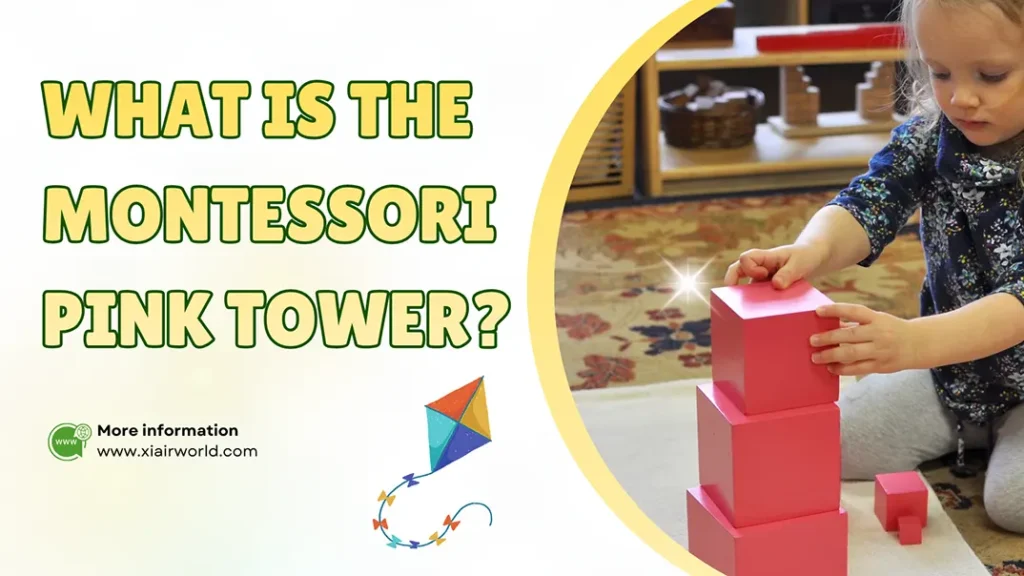
The Montessori Pink Tower is a set of ten precisely graded cubes used in Montessori classrooms to develop a child’s sense of size, order, and spatial awareness. Each cube differs by exactly one centimeter, creating a mathematical progression that supports early cognitive and mathematical foundations.
Ask any Montessori educator about the essential materials for a well-prepared classroom, and the Pink Tower will almost always be mentioned first. Its presence is not based on tradition alone, but on the powerful way it helps children move from simple sensory exploration to structured thinking.
Keep reading. By examining its design features, developmental benefits, and classroom use, we can see how a seemingly simple set of cubes plays a lasting role in early learning.
Design Features of the Montessori Pink Tower
The effectiveness of the Montessori Pink Tower comes from intentional design rather than visual appeal. Every element, from size progression to color choice, serves a specific educational purpose. These features allow the material to isolate one learning variable while supporting cognitive development through hands-on interaction.
Precise Dimensional Progression
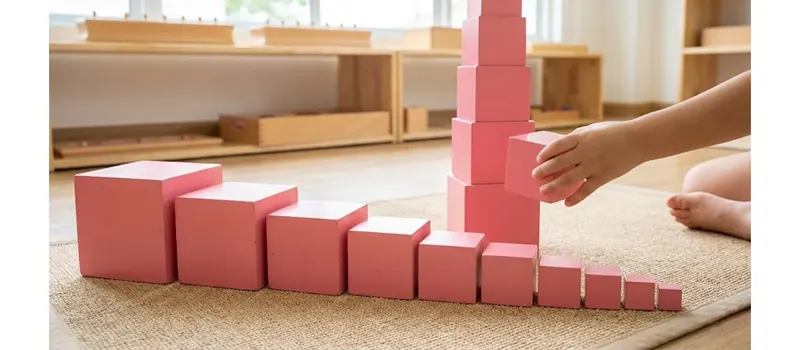
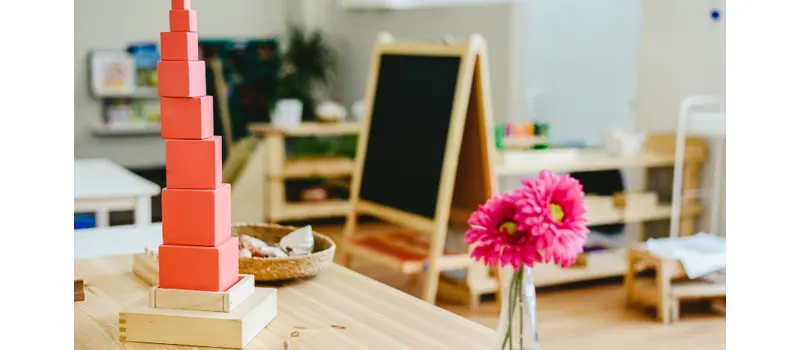
The Pink Tower consists of ten wooden cubes that decrease in size in exact one-centimeter increments. The largest cube measures 10 centimeters per side, and the smallest measures 1 centimeter. This mathematical consistency is not decorative. It introduces children to ordered gradation and prepares the mind for later understanding of volume, proportion, and the decimal system. Through physical manipulation, children experience quantitative change concretely.
Isolation of Quality
All cubes are painted the same shade of pink to eliminate visual distractions. By removing color variation, the material ensures that children focus exclusively on differences in dimension. This design principle, often described as isolating a single quality, strengthens visual discrimination and helps children refine their ability to observe subtle size differences.
Control of Error Built into the Material
The Pink Tower allows children to recognize mistakes independently. If cubes are placed in the wrong order, the imbalance is immediately visible and physically noticeable. This built-in control of error encourages self-correction, concentration, and confidence. The learning process becomes internally guided rather than dependent on constant adult intervention.
Material Weight and Density
An authentic Pink Tower has a specific weight. As the cubes increase in size, their weight increases exponentially. When a child carries the largest cube to their rug using two hands, their muscles register the effort required. This “muscular memory” is a crucial part of the learning process. It teaches the child that “larger” also means “heavier”, grounding a mathematical concept in a physical reality.
What Is the Purpose of the Montessori Pink Tower?
The purpose of the Montessori Pink Tower is to help children develop visual discrimination of dimension while building the mental foundations for logical thinking and mathematical understanding. Although it appears to be a simple stacking activity, its deeper goal is to train the child’s mind to recognize order, gradation, and spatial relationships through direct sensory experience.
Refining Visual Perception of Size
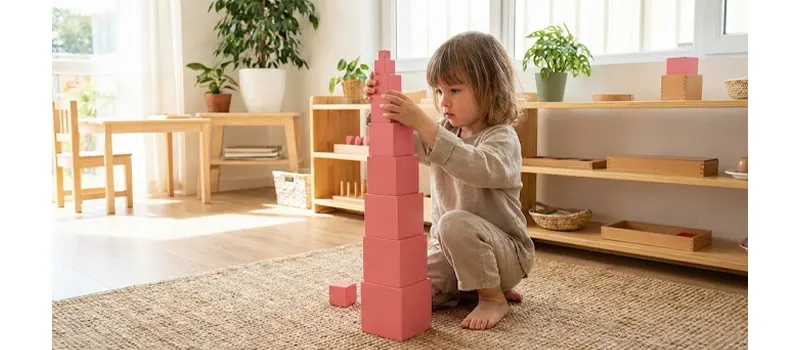
One of the primary objectives of the Pink Tower is to strengthen a child’s ability to distinguish small differences in dimension. By handling cubes that decrease in size in consistent increments, children train their eyes to detect variation in height, width, and depth. This refined perception supports later work in geometry, measurement, and spatial reasoning.
Establishing a Sense of Order and Sequence
Montessori education emphasizes the importance of internal order as a foundation for thinking. The Pink Tower introduces a clear sequence from largest to smallest, allowing children to construct order physically. Repeating this activity helps build logical sequencing skills and an understanding that size relationships follow predictable patterns.
Indirect Preparation for Mathematics
While the child is not being directly taught mathematical formulas, the Pink Tower prepares the mind for quantitative thinking. The consistent size progression introduces the idea of systematic change, which supports later understanding of volume, powers, and the decimal structure. It connects sensory experience to abstract concepts that will emerge in future lessons.
Supporting Concentration and Cognitive Control
Working with the Pink Tower requires focus, careful movement, and attention to detail. As children repeat the activity, they strengthen concentration and develop persistence. These executive function skills are essential for later academic learning and independent problem-solving.
What Is the Appropriate Age to Introduce the Pink Tower?
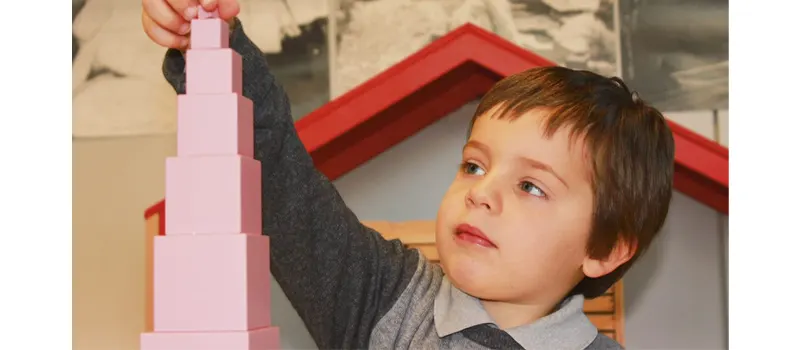
In the Montessori curriculum, the introduction of materials is guided by “Sensitive Periods”—specific windows in a child’s development where they are naturally drawn to certain skills. For the Pink Tower, this usually occurs between the ages of 2.5 and 3.5 years old. At this stage, children are moving out of the phase of unconscious exploration and into a period where they seek to categorize and order their sensory experiences. However, readiness is always determined by individual observation rather than a strict chronological birthday.
Before introducing the Pink Tower, an educator looks for specific developmental markers. The child should demonstrate a basic “sense of order,” such as the ability to return a simpler activity to its place on the shelf. They also need the gross motor coordination required to carry the larger, heavier cubes without dropping them, and the fine motor strength to manipulate the smallest $1cm^3$ cube.
How to Use Pink Tower in Montessori?
In a Montessori classroom, the Pink Tower is introduced through a structured presentation that allows the child to discover size relationships independently. The goal is not speed or performance, but careful observation, controlled movement, and internal understanding of order.
Preparation of the Environment
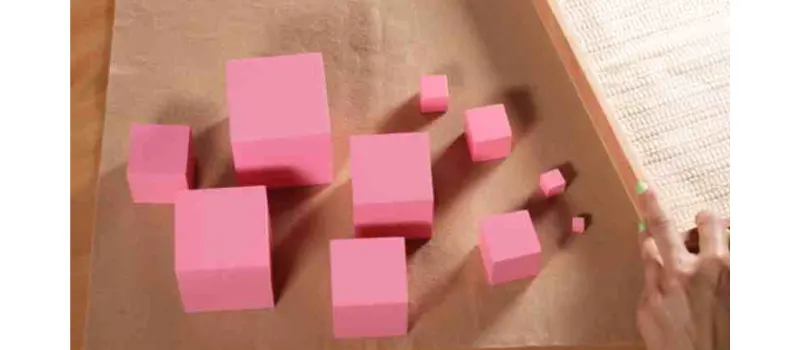
The Pink Tower is displayed on a low, accessible shelf where all cubes are arranged neatly from largest to smallest. A floor work mat is used to define the child’s workspace and create a clear boundary. This organization supports independence and helps the child develop respect for materials and spatial order.
Initial Presentation by the Teacher
The teacher invites the child and demonstrates the activity slowly and with minimal language. Each cube is carried to the mat one at a time using both hands, emphasizing controlled movement and care. The largest cube is placed first, and the tower is built progressively in size order.
The demonstration highlights action rather than explanation. The teacher’s precise, quiet movements draw the child’s attention to differences in dimension without overwhelming verbal input.
Child’s Independent Work
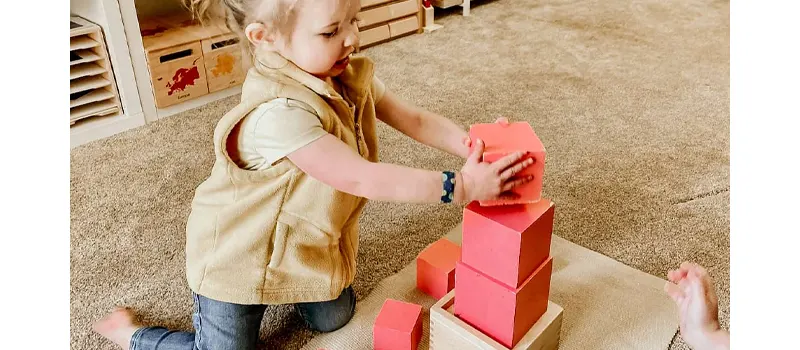
After the presentation, the child is invited to try independently. The teacher steps back to observe, allowing the child to repeat the activity as needed. Repetition strengthens concentration, coordination, and visual discrimination. Children may explore variations once they have mastered the basic sequence, which deepens their understanding of gradation.
Control of Error Through Physical Feedback
If cubes are placed out of order, the imbalance of the structure becomes visible and physically noticeable. This built-in control of error allows the child to recognize and correct mistakes independently, reinforcing confidence and self-guided learning.
Language Extension Through the Three-Period Lesson
Once the child is comfortable working with the Pink Tower, vocabulary related to size can be introduced using the Three-Period Lesson. Words such as big, small, bigger, and smallest are connected to the child’s sensory experience. Language follows understanding, allowing the child to attach precise words to concepts already formed through action.
Returning the Material as Part of the Work Cycle
Finishing the activity includes dismantling the tower and returning each cube to the shelf one at a time in order. This process reinforces sequence, responsibility, and respect for the environment. Returning the material is not simply a cleanup, but a meaningful conclusion that completes the learning cycle.
How to Choose a Montessori Pink Tower?
Because the Montessori Pink Tower is a scientific instrument designed to teach precise mathematical concepts, the integrity of its manufacturing directly impacts its educational value. Choosing the right tower means looking for specific markers of quality that ensure the material remains a functional “Control of Error” for years to come.
Accuracy of Dimensions
The most important factor is measurement precision. Each cube should decrease in one centimeter increments, from 10 centimeters down to 1 centimeter. Inaccurate sizing reduces the clarity of visual discrimination and weakens the material’s educational purpose.
Material Quality and Weight
Solid wood is preferred because it provides stability and appropriate weight. A well-balanced cube offers sensory feedback and supports controlled movement. Lightweight or hollow materials can make stacking unstable and reduce the quality of the experience.
Surface Finish and Safety
The finish should be smooth, non-toxic, and durable. Rough edges can distract the child and interfere with handling, while safe coatings ensure the material is suitable for daily classroom use. A consistent matte finish also helps maintain focus on dimension rather than surface shine.
Consistency of Color
All cubes should have the same shade of pink. Variations in color create unnecessary visual differences, shifting attention away from size. Uniform color is essential to preserve the principle of isolating one quality.
Durability for Classroom Use
In educational settings, materials are used frequently. Strong construction, well-sealed surfaces, and stable edges help the Pink Tower withstand long-term classroom use without warping or chipping.
Respect for Montessori Design Principles
A high-quality Pink Tower reflects an understanding of Montessori pedagogy, not just product manufacturing. Precision, simplicity, and proportion must be maintained so that the material functions as intended in the learning process.
Extensions Activities Beyond the Basic Pink Tower
Once a child has mastered building the Pink Tower in the correct size order, the material naturally opens the door to deeper exploration. These extension activities are not random variations but purposeful experiences that expand the child’s understanding of dimension, comparison, and spatial relationships.
1. The Stereognostic (Blindfold) Challenge
The “Stereognostic Challenge” involves the use of a blindfold to completely remove the child’s visual sense, forcing them to rely entirely on tactile and muscular perception. By feeling the surface area and weight of each cube, the child must internalize the dimensions to successfully sequence the tower. This exercise intensifies their concentration and deepens the “muscular memory” of volume, allowing the child to “see” through their hands and achieve a more profound level of sensory refinement.
2. Integration with the Brown Stair
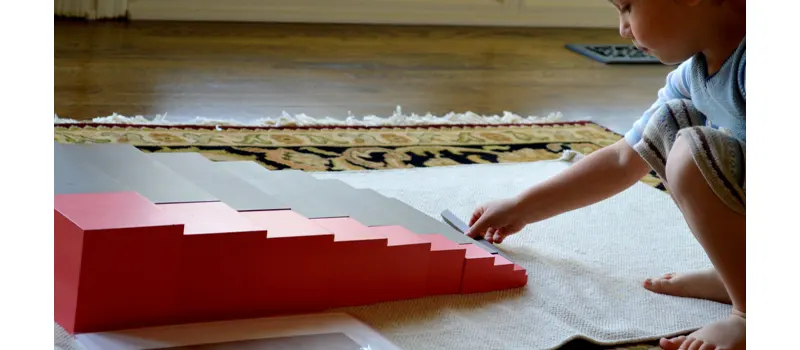
This activity allows the child to discover the harmonious relationship between different dimensions, such as matching the $10cm$ base of the largest pink cube with the $10cm$ length of the brown prisms. By building complex architectural structures like spirals or bridges using both materials, the child engages in a sophisticated exploration of geometry, comparing height, width, and length in a unified physical space.
3. Two-Dimensional Pattern Matching
To help children move from concrete objects toward abstract understanding, educators introduce card matching, where the child aligns the cubes with paper squares of the exact same dimensions. This task requires the child to translate a three-dimensional volume into a two-dimensional shape, a critical step in developing spatial reasoning.
4. The Memory Distance Game
The “Distance Match” is designed to strengthen a child’s mental retention and visual memory. In this activity, the work mat and the shelf are placed on opposite sides of the room, requiring the child to identify the specific cube needed, hold that precise visual image in their mind, and walk across the room to retrieve it. This exercise challenges the child to maintain focus and sensory information over time and distance, building the cognitive endurance necessary for complex problem-solving.
Common Mistakes When Using the Montessori Pink Tower
Common pitfalls often stem from a misunderstanding of the material’s “indirect aims” or an eagerness to see the “perfect” result rather than honoring the child’s process. Recognizing these mistakes is the first step toward creating a truly supportive space where the child feels empowered to explore and self-correct without unnecessary interference.

Presenting the Material Too Early
One of the most frequent errors is introducing the Pink Tower before a child has developed the necessary coordination or “sense of order.” If a child is still in a phase of broad, gross motor exploration, the tower may be treated as standard building blocks to be knocked down. モンテッソーリ教材 are designed for purposeful work; if the child isn’t ready to handle the cubes with care, the pedagogical intent is lost in the chaos of play.
Intervening During the Learning Process
A common pitfall for adults is the urge to correct a child the moment they place a cube out of sequence. In Montessori, the “Control of Error” is built into the material itself. When an adult steps in to say, “No, that one goes there,” they strip the child of the opportunity to observe the mistake independently. This intervention prevents the development of self-correction and can discourage the child from experimenting further.
Skipping the Preparation of the Workspace
Because the Pink Tower involves ten separate pieces that must be moved one by one, the environment must be prepared. A common mistake is allowing a child to build the tower on an uneven surface or a crowded rug. Without a clear, defined work mat, the tower becomes unstable, and the visual focus is diluted. Providing a neutral, flat surface ensures that the child’s eyes are fixed solely on the relationship between the cubes, not on the clutter around them.
Using Inaccurate or Damaged Materials
For the sensory experience to be valid, the material must be precise. If a tower is missing a cube, or if the cubes are chipped so badly that they no longer sit flush, the mathematical logic is broken. A $1cm$ difference is a subtle visual cue; if the edges are rounded from wear or the paint is peeling unevenly, the child receives “noisy” sensory data. Maintaining a pristine, high-quality set is not about aesthetics—it is about protecting the integrity of the educational lesson.
よくある質問
How is the Pink Tower different from regular stacking blocks?
Unlike ordinary blocks, the Pink Tower follows a precise mathematical gradation and isolates size as the only variable. Its purpose is structured sensorial learning, not open-ended construction.
Why is the Montessori Pink Tower pink?
The Montessori Pink Tower is pink to eliminate visual distractions and isolate dimension as the only variable the child needs to focus on. The soft pink tone is also visually calm and consistent across all cubes, helping the material stand out on the shelf without overwhelming the child’s senses.
Can the Pink Tower be used at home?
Yes, it can be used at home when presented in a calm, structured way. However, its effectiveness depends on proper demonstration and an environment that supports concentration and independence, rather than treating it as a general building toy.
How do you know when a child has mastered the Pink Tower?
Mastery is seen when the child builds the tower accurately, handles the cubes with care, maintains focus, and can recognize errors independently. At this stage, extension activities may be introduced to deepen understanding.
結論
The Montessori Pink Tower shows how thoughtful material design can shape the way children think. Its precise gradation, controlled color, and built-in self-correction transform a simple set of cubes into a powerful tool for developing perception, order, concentration, and early mathematical reasoning.
Because this material relies on accuracy and proportion, its educational effectiveness is closely tied to manufacturing quality. At シアールワールド, we approach Montessori materials with precision. Each Pink Tower is produced with consistent measurements, smooth finishes, and durable construction suitable for daily use in learning environments.