
 Japanese
  English
  Arabic
  French
  Italian
  German
  Spanish (Spain)
  Thai
Thai  Turkish
  Indonesian
  Vietnamese
  Polish
  Portuguese
  Malay
Malay  Swedish
  Spanish (Mexico)
When you buy storage for daycare room, the product list is easy. The hard part is knowing what each room can use. A low shelf that works in a preschool room may be too busy beside a toddler play area. A large cabinet may hold plenty, but still make a small room hard to supervise.
Start with the age group, the room, and the activities. Then choose the storage type and the details. For the wider question of how you keep a classroom working from day to day, read the preschool classroom organization guide.
Choose Storage For The Age Group
Your children’s age changes how high materials should sit, how much choice you can leave out, and which items need adult help. You should not use the same storage plan in every daycare room.
Infants And Young Toddlers
Keep the floor open and the room easy to see. Use low, stable storage for a small number of safe materials that you can check quickly. Keep staff supplies, cleaning products, medication, and other restricted items in secure storage that follows your local rules.
At this age, storage should not create extra corners for crawling bodies, loose parts, or bags. Keep personal items near the entry, and keep the main play area clear enough for floor play and movement.
A useful product list for this age is:
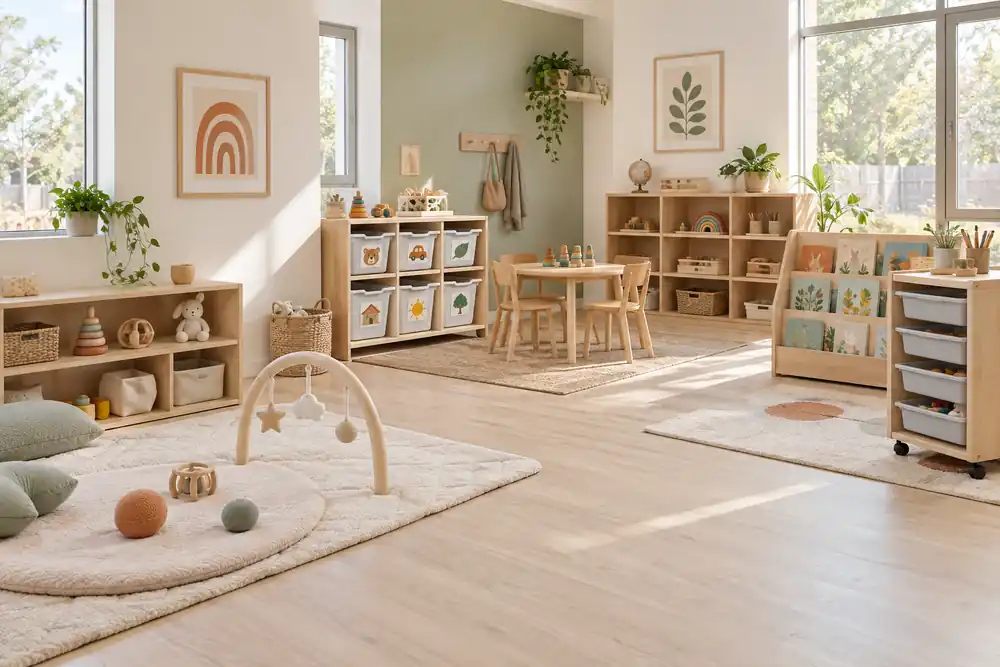
- a low open storage unit for a small set of safe daily materials
- low cubbies near the entry for bags and spare clothes
- a closed or lockable cabinet for staff supplies and restricted items
幼児
Toddlers need simple choices and storage that is easy to carry back. Low open shelves, light trays, and picture labels can help you build a clear take-and-return routine.
Do not fill every shelf. A smaller number of visible choices makes it easier to see what is being used and reduces the amount of material that ends up on the floor. Avoid deep bins that are hard to lift or shelves that require a child to reach over another child.
For a toddler room, you may need:
- a low shelf with trays for daily play materials
- picture-labeled bins for larger loose parts
- cubbies for personal items
- a small mobile unit for materials that move between areas
Preschool Groups
You can offer more independent choice as children grow. Open storage can hold books, blocks, puzzles, pretend-play materials, and some art resources close to the areas where you use each material.
Use labels, trays, and clear groups so that children can find and return materials without emptying the whole unit. Keep less-used themes and extra stock out of the working area so that the room does not become crowded with choices.
A preschool room often works better with:
- open compartment storage for blocks, puzzles, and pretend play
- a front-facing classroom bookshelf for books
- a mobile tray unit for art or rotating materials
- a closed or lockable cabinet for spare supplies and staff-only items
| Age group | Keep easy to reach | Keep separate or secure |
|---|---|---|
| Infants and young toddlers | A small set of safe, familiar materials | Staff supplies, cleaning products, medication, and loose small parts |
| 幼児 | Simple trays, books, blocks, and picture-labeled materials | Heavy containers, extra stock, and materials needing adult help |
| Preschool groups | Books, puzzles, blocks, pretend play, and selected art materials | Seasonal materials, spare supplies, and restricted items |
This table is a planning guide, not a replacement for your local childcare rules or the safety instructions for a particular product.
This approach follows a simple point in Head Start’s responsive learning environment guidance: keep safe materials easy to access, but do not put so much out that the room becomes hard to use.
Look At The Room Before You Choose Storage
Room size changes the answer. Before you choose a unit, mark the door swing, windows, handwashing area, fixed equipment, power points, main paths, and the places where children play on the floor.
Small Rooms
In a small room, use each unit for a clear purpose. A low shelf can divide two areas without blocking the view. A deeper unit may hold more, but it can take too much walking space. Check the usable depth and the space needed in front of doors, drawers, and trays.
Do not fill every wall just because a wall is empty. Leave room for movement, displays that children can see, and the clear view you need during the day.
その NAEYC early learning standards make the same connection between low, open shelves, clear paths, and supervision. Use that as a useful check when you review a small-room layout.
Shared Rooms
If you change the room for meals, small-group work, nap time, or different age groups, mobile storage can help. Give each mobile unit one clear job and one clear home. Check the load, the casters, the locking system, and the space needed to move it before you choose a mobile design.
If a unit is moved only once a year, fixed storage may be simpler. Use mobile storage when the room really changes often, not just because casters look flexible in a product photo.
Rooms With Built-In Storage
Built-in cupboards do not always solve the daily storage problem. Check what they can hold, who can reach them, and how far they are from the activity areas. You may still need low open storage near the children’s work areas and secure storage for staff materials.
Use the existing storage for less-used or staff-only items when possible. Then add only the pieces that solve a clear gap in the room.
Put Storage Beside The Activity
The best storage position is usually close to the place where you use the material. This reduces carrying, shortens clean-up, and makes it easier to see when an item is in the wrong place.
Art And Messy Work
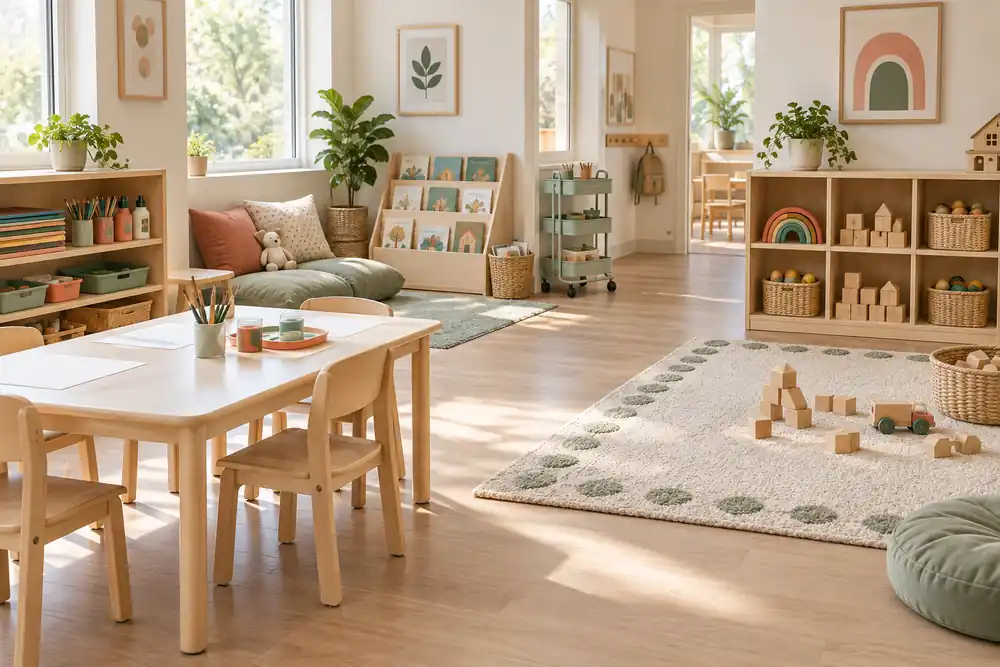
Keep paper, brushes, and everyday tools near the art area. Place items that need adult help in a separate closed section or staff area. Keep the surface near the supplies easy to wipe, and do not place a mobile unit where it blocks the sink, door, or main path.
Books And Quiet Play
Keep book storage near the reading area and away from the busiest route. Front-facing displays help children see the covers. A shelf that is too deep may hold more books but hide the choices you want children to notice.
You can see more options for this use in the classroom bookshelf collection.
Blocks, Pretend Play, And Floor Work
Keep blocks and large play materials close to the floor area where children build and play. Use open compartments or trays that make the size of each group clear. Personal bags and coats should not share this storage, or the play area will quickly turn into an entry area.
Shared And Rotating Materials
Use a cart or mobile unit for materials that move between activity areas. Use fixed storage for items that stay in one place. Store seasonal themes and extra materials separately so that the room only holds what you are ready to use.
Use More Than One Storage Type
You will usually need a mix of storage rather than one large cabinet. Each type should have one main job.
Cubbies For Personal Items
Use cubbies near the entry for bags, coats, shoes, lunch items, and spare clothes. Picture labels can help younger children find the right space. Keep personal storage separate from learning materials so that the entry does not become a general dumping area.
Open Shelves For Daily Use
Use low open shelves for materials children choose and return. Keep the most-used items within comfortable reach, and avoid filling every compartment. Labeled trays or baskets can help, but a child should not have to move several heavy containers to reach one item.
If you are comparing open units, cabinets, cubbies, and mobile pieces, the classroom storage collection shows how internal layouts, bases, doors, locks, and casters can be matched to a room plan.
Mobile Units When Materials Move
Use mobile storage for shared art supplies, rotating activities, or materials that move between rooms. Check the unit’s weight, base, casters, and locking system. Give it a clear parking place so that it does not sit in a doorway or become a place for unrelated items.
Closed Cabinets For Staff Storage
Use closed or lockable storage for staff materials, spare stock, cleaning products, medication, sharp tools, and other restricted items. Check the door hardware, the fixing method, and the cabinet’s stability. A closed door by itself does not answer every safety question.
You can combine open and closed sections when the room is small. Keep the child-accessible and staff-only parts easy to tell apart.
Check The Details Before Ordering
Once you know where the storage will go, check the details that affect daily use. A product can fit the wall and still fail to fit the materials, the walkway, or the way you clean the room.
Depth And Reach
Measure the wall, the path in front of the unit, and the space needed for doors or drawers to open. Check usable internal depth, not only the outside measurement. A shallow unit may protect the walkway but fail to hold trays. A deep unit may hold more but make the room feel tight.
Shelves, Back Panels, And Load
Check how the internal layout will carry the materials you plan to store. Wide shelves, tall cabinets, and sections loaded with books or blocks may need more support than a small tray unit.
Do not choose panel thickness by price alone. The right construction depends on the width, height, load, shelf span, and support inside the unit. Confirm the shelf positions, back panel, edges, and fixing points on the final product drawing.
Bases, Casters, And Fixing
Choose a floor-level plinth, raised feet, or casters according to how you clean and use the room. Casters can help you change the layout, but the base and caster rating must match the unit and its load.
Ask how tall or mobile storage will be secured. Your local rules may require wall or floor fixing, and the fixing point must work with the wall construction.
Finish, Doors, And Delivery
Check the edges, joints, handles, hinges, doors, locks, and corners. You will touch, wipe, open, and load the unit every day, so these details matter more than a finish that only looks good in a catalogue photograph.
Before production, confirm the width, height, usable depth, shelf positions, door movement, finish, fixing points, and delivery format. This check can prevent a unit from arriving with the right outside size but the wrong inside arrangement.
よくある質問
- How much storage should you plan for a daycare room? Start with an inventory of what you use now, what you rotate, and what needs secure storage. You need enough working storage without filling every wall or blocking movement.
- Can you use the same storage in every age group? You can keep a similar outside style, but the height, compartments, trays, doors, and access should follow the age group and the materials in each room.
- Is open storage always better for children? Open storage works well for safe daily materials that children can choose and return. You still need closed or locked storage for restricted items, extra stock, and materials that need adult help.
- When should you choose mobile storage? Choose it when materials regularly move between activity areas or the room changes during the day. If the unit rarely moves, fixed storage may give you a simpler and more stable layout.
- What should you prepare before asking for a storage plan? Prepare room measurements, a floor plan or clear photos, door and window positions, the age group, the number of children, the main activities, the material list, and any items that need locks or special fixing.
結論
The best storage solutions for a daycare classroom start with the age group, the room, and the activities. Choose low and simple access for younger children, place materials close to the work area, and keep staff or restricted items separate. Then check depth, support, bases, fixing, and daily care before you order. If you need several rooms to look consistent while using different internal layouts, Xiair Word can help you review the room plan and storage details together. You can visit Xiair Word for the wider classroom product range.