
 German
 English
 Arabic
 French
 Italian
 Spanish (Spain)
 Thai
 Japanese
 Turkish
 Indonesian
 Vietnamese
 Polish
 Portuguese
 Malay
 Swedish
 Spanish (Mexico)
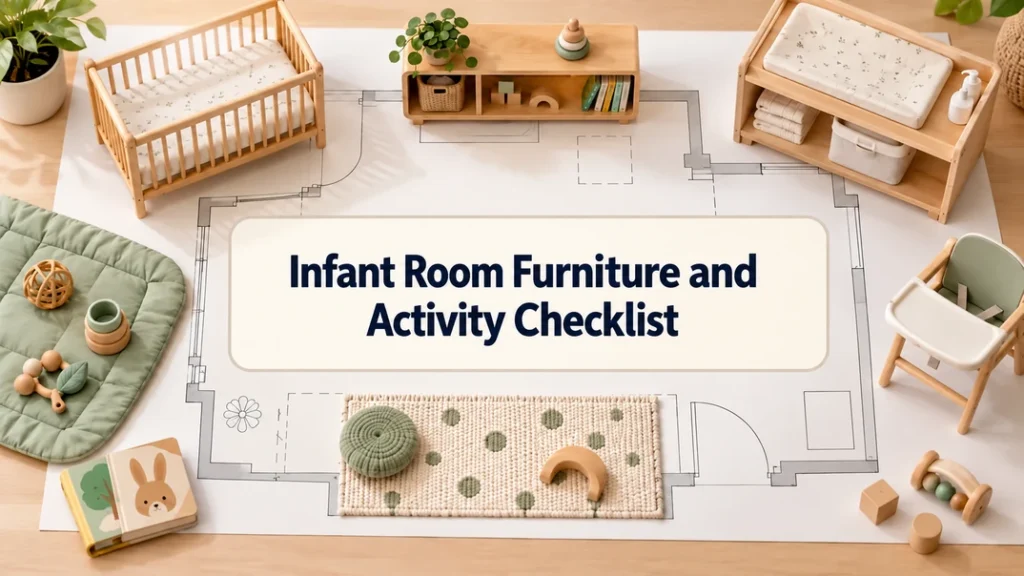
An infant room is not a smaller toddler classroom. One baby may need a feed while another is asleep and a third is ready to move on the floor. A useful infant room furniture checklist therefore has two parts: the care equipment you rely on every day, and the activity materials that fit what each baby can do now. Use this guide to decide what belongs in the room, what can wait, and what to check before you order.
Picture one ordinary morning, not an empty room
Before you choose products, note how many infants use the room at the same time and what they can do: watch and reach, roll, crawl, or pull up. Then follow the care tasks that happen around them. Where do clean supplies come from? Where do used items go? Can a caregiver sit with an awake baby while another adult handles a feed or a change? Your answers tell you which furniture needs a permanent place and which materials can rotate.
If you are creating a Montessori-specific infant space, the Montessori Nido guide explains that approach in detail. Here, the focus is the working checklist for a daycare infant room, whatever teaching approach you use.
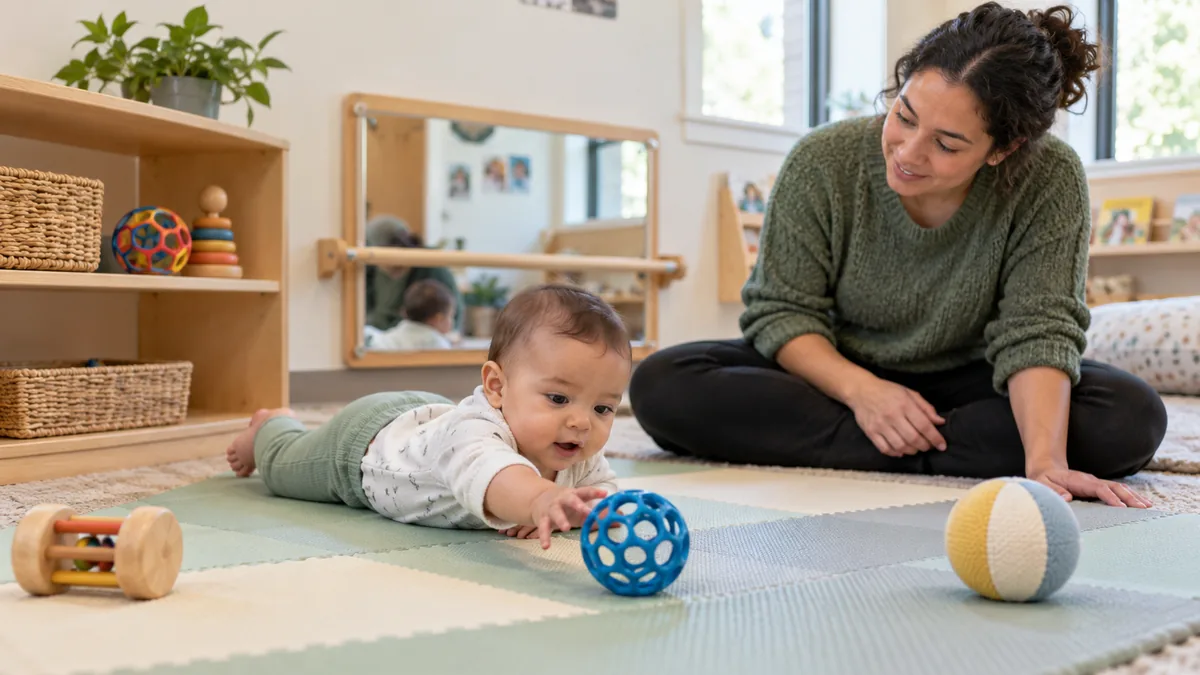
Changing, feeding, and sleep need complete setups
These are not three products to tick off a shopping list. Each is a short sequence of actions. Check the whole sequence before you decide on a single piece of furniture.
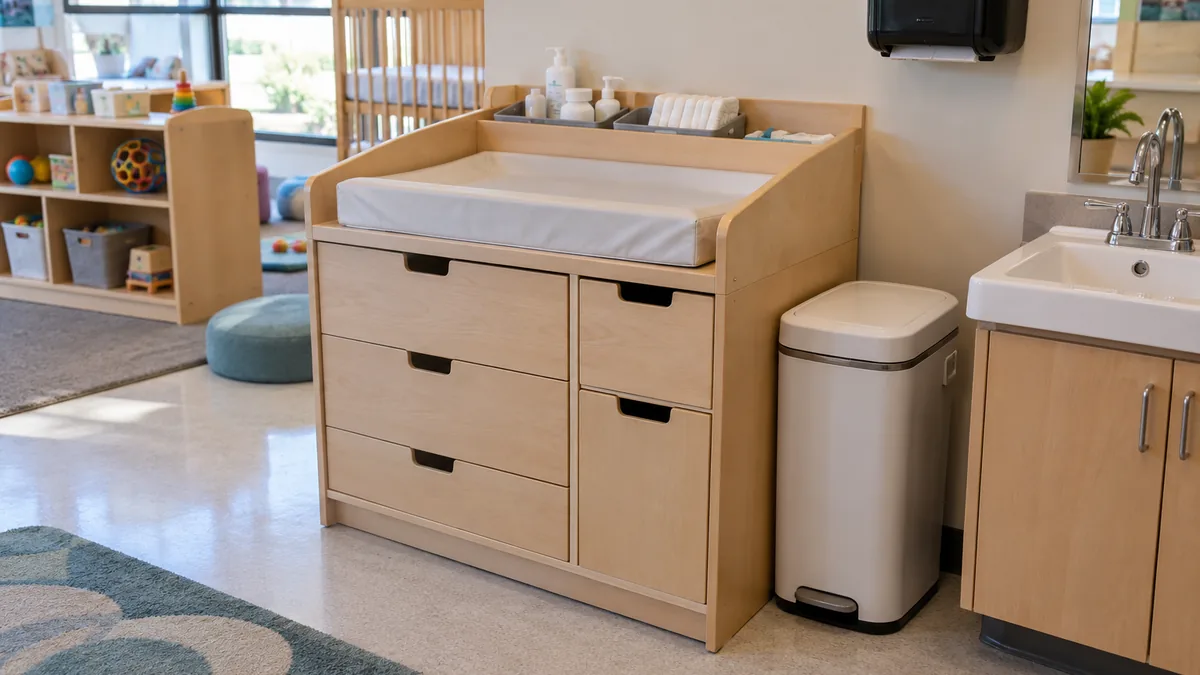
Changing takes more than a changing table
Walk through a full diaper change at the station, using the CDC’s childcare diaper-changing steps as a guide and following your local rules. Check for a stable surface, clean supplies within adult reach, a place for used items, and a handwashing route. Keep cleaning products out of children’s reach. Check the pad edges and the join between the top and frame: if residue collects there, a surface that looks smooth in a photo may be difficult to maintain in daily use.
Give each child’s spare clothes and personal items a labeled place away from shared play materials. If you need to sort what belongs on child-accessible shelves and what staff should control, the daycare storage guide goes into that decision.
Remember the adult when you plan feeding
A supportive adult chair belongs in the feeding plan because the caregiver needs to hold and respond to the infant, not prop a bottle. When a child is ready for supported meals, check the seating model’s intended use, restraint, body support, and cleanable tray. Do not buy a classroom table-and-chair set just because it appears in a general furniture package. The furniture size guide by age explains why standard classroom seating is usually not the starting point for the youngest infants.
Keep sleep furniture out of the play category
Choose infant sleep equipment to meet the rules where your center operates; a floor-play mat is not a substitute. Confirm the mattress and fitted sheet match the sleep product, and keep play materials out of it. For routines and equipment choices across age groups, use the nap-time guide. The American Academy of Pediatrics provides general safe-sleep guidance.
For awake time, follow what the baby can do
Do not build the play list from an age label alone. Watch what an infant is trying to do, then offer a small, safe invitation to repeat it. The furniture’s job is to make that action possible without taking over the floor.
| What you notice | An activity to support | What earns space in the room |
|---|---|---|
| The baby watches faces and follows sound. | Face-to-face talk, a song, or a short board book shared with a caregiver. | A comfortable place for the adult to sit at infant level and a few books. You do not need a separate activity station. |
| The baby reaches, turns, or looks toward a reflection. | Offer one large grasping object within reach, or share supervised mirror play. | A firm, cleanable floor surface and, if you use a mirror, one installed for infant use. See the mirror-play ideas for ways to use it. |
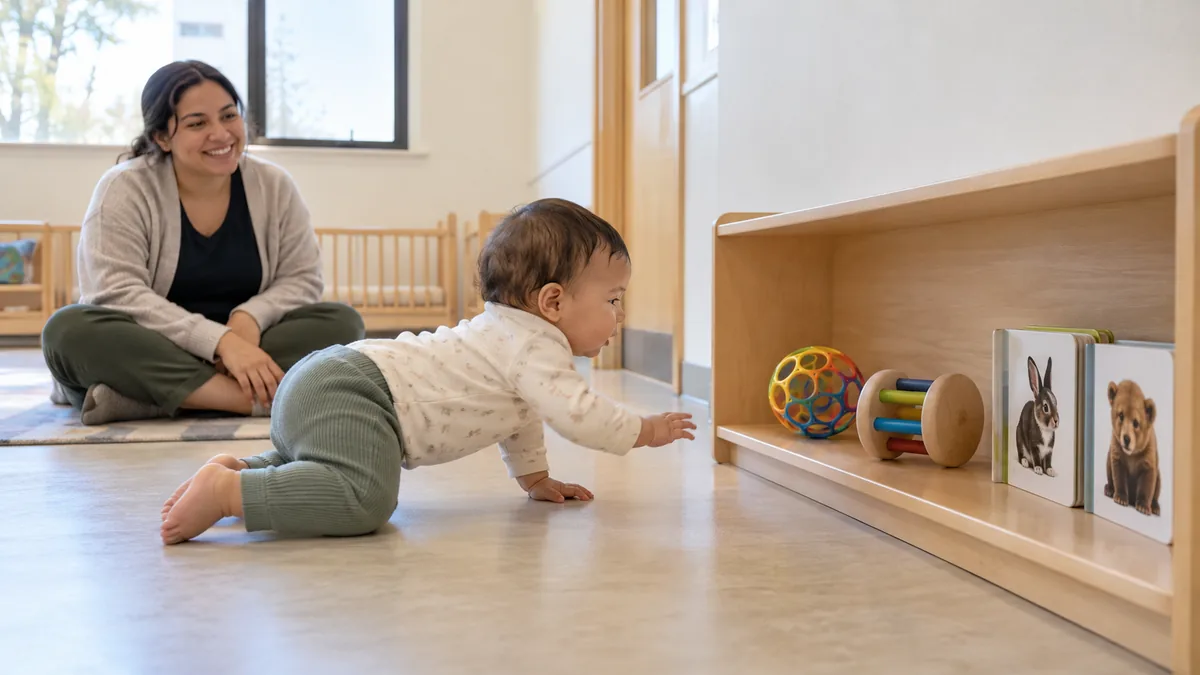
| The baby rolls or crawls toward a choice. | Let the child approach and explore one of a few large, age-appropriate objects. | Clear floor and a low, secured display. Keep its top empty and check what becomes reachable as babies grow. |
| The baby drops, retrieves, and repeats an action. | Use a simple container and large objects that are suitable for the child and your group-care setting. | A small set of materials that staff can inspect and clean; no dedicated table is required. The object-permanence guide explains this developing interest. |
| The baby begins to pull up. | Offer supervised opportunities to practice standing at a support designed for that purpose. | A support that can be securely installed in your actual room, with no loose parts or tipping furniture nearby. |
As hand use becomes more precise, some activities call for much smaller objects than you would leave on an open infant shelf. The pincer-grasp activity guide offers ideas, but check each suggested material against your center’s age, small-parts, and supervision rules before using it in a group room.
Try two routines at the same time
A furniture list can look complete and still fail when the room is busy. Put the full-size footprints of the changing station, feeding chair, sleep furniture, and low display on your plan. Then have someone sit where an adult would feed a baby while another person follows the route to changing and handwashing. Open any drawers and doors along the way. Can staff move and see the awake play area without stepping into it or setting supplies on the infant shelf?
Repeat the test with one infant resting and another using the floor. If a piece only works when every other activity stops, reconsider its position or whether you need it at all. This is a better test than judging the furniture one item at a time.

Ask for more than a product photo
Before ordering, request the full dimensions, including the space a drawer or tray needs when open. Ask how shelves, mirrors, and pull-up supports are fixed to the surface you have; whether the finish tolerates your cleaning routine; and whether pads or hardware can be replaced. Match the product’s intended use and documentation to the country where it will be installed. The daycare furniture safety standards guide helps you identify the questions to ask for that market.
Change the list when the children change
You do not need to refurnish the room every time a baby gains a new skill. Keep the care and approved sleep equipment that still fits, then review what can be reached, pulled, or mouthed. Rotate activity materials and add a new support only when the children can use it and the installation is right for your room.
When children move into a toddler room, use a separate toddler room checklist for independent access, group activities, and larger movement. Infant furniture should not simply be carried forward because it still looks small enough.
FAQs
- Can donated or secondhand furniture go straight into an infant room? No. Identify the model and check for recalls with the relevant regulator; for U.S. settings, use the CPSC recall search. Then inspect the hardware, obtain the use and cleaning instructions, and confirm that the item meets the rules for your setting. If you cannot verify a sleep or restraint product, do not place it in service.
- What should staff do when an activity item is damaged? Remove it from infant access immediately and mark it for review. Check whether a manufacturer-approved repair or replacement is possible before returning it to use. Include a quick condition check when you reset the activity materials each day.
Abschluss
Your final order should make an ordinary day easier to care for, not just make the room look finished. If you need help matching the selection to your program, Xiair Welt can help you plan it.