
 Spanish (Mexico)
  English
  Arabic
  French
  Italian
  German
  Spanish (Spain)
  Thai
Thai  Japanese
  Turkish
  Indonesian
  Vietnamese
  Polish
  Portuguese
  Malay
Malay  Swedish
When you choose classroom furniture, “eco-friendly” should help you make a better decision, not simply give you another label to trust. You need to know where the forest-based material comes from, what the FSC claim actually covers, how the furniture will perform after years of cleaning and daily use, and whether the whole setup fits your classroom.
FSC certification can give you useful evidence about responsible forest-based material and supply-chain control. It does not, by itself, confirm that every part of a furniture item is low-emission, child-safe, durable, repairable, or suitable for your age group. This guide shows you how to assess those questions together.
What “Eco-Friendly Classroom Furniture” Should Mean
For a classroom, a lower-impact choice is rarely decided by one material or one certificate. You need to look at the complete use cycle: sourcing, construction, daily maintenance, expected service life, repair, replacement parts, packaging, and disposal.
Use these five tests before you call a product eco-friendly:
- Responsible sourcing: You can identify the source and certification claim for wood, plywood, veneer, paper-based panels, or other forest-based components.
- Clear material construction: You know which parts are solid wood, engineered wood, laminate, plastic, metal, adhesive, finish, or hardware. A certified wood surface does not automatically make every component certified.
- Safe daily use: You can review the finish, adhesive, edge treatment, and cleaning instructions separately from the FSC claim. FSC is not an indoor-air-quality or chemical-emissions certification.
- Long service life: The furniture can handle repeated sitting, moving, wiping, spills, storage access, and ordinary classroom impact without becoming difficult to repair.
- Practical end of life: You can identify replaceable parts, separate materials where possible, and avoid replacing a complete unit when one component is worn.
This is why a durable table that remains useful for many room changes can be a better environmental decision than a product made from a preferred material but replaced quickly. You should evaluate the material and the way you will use it together.
What FSC Certification Actually Tells You
FSC certification focuses on forest-based material and the chain of custody that connects a certified source to a finished product. The three on-product FSC label types communicate different material claims:
| FSC label | What the claim means | What you still need to check |
|---|---|---|
| FSC 100% | The forest-based material covered by the label comes from FSC-certified forests. | Finish, adhesives, hardware, metal, plastic, emissions, dimensions, and durability. |
| FSC Mix | The product uses a combination of FSC-certified material, recycled material, and/or FSC-controlled wood. | Which components carry the claim and how the complete furniture specification is documented. |
| FSC Recycled | The material covered by the label is made from 100% recycled material. | The structure, surface performance, non-wood components, repair options, and cleaning requirements. |
| FSC Chain of Custody | Forest-based material is identified and tracked through relevant manufacturing and distribution steps so an eligible FSC claim can be made. | Whether the supplier’s certificate is current, covers the product category, and supports the claim on your order documents. |
You can compare the label definitions in the official FSC label guide. The key point is simple: FSC tells you something meaningful about the forest-based material and its documented supply chain. It does not rank the furniture’s comfort, strength, cleanability, classroom layout, or total environmental impact.
FSC Mix should not automatically be treated as a lower-quality option than FSC 100%. The labels describe sourcing models, not the strength or finish quality of a chair, table, cabinet, or shelf. You still need the product specification and the correct claim for the exact item.
How to Verify an FSC-Certified Furniture Claim
You should verify the claim before approving a sample or production order. A supplier saying “FSC wood” is not the same as providing a documented FSC claim for the finished furniture.
1. Ask for the certificate code
Request the supplier’s FSC certificate code and check it in the FSC certificate database. Use the current certificate information, not an old image, catalog page, or certificate from a different company in the supply chain.
2. Check the certificate scope
The certificate should cover the relevant activity and product category. A certificate may cover some forest-based products but not every product made in a factory. If you are ordering classroom tables, chairs, storage, or custom units, ask whether the specific product group is included.
3. Map the claim to the furniture
Ask which parts of the item carry the FSC claim:
- solid wood legs or frames;
- plywood or particleboard cores;
- veneer or wood-fiber surfaces;
- paper-based laminate or other forest-based layers;
- packaging, when packaging is claimed separately.
Then ask which parts are outside the claim. This prevents a common misunderstanding: an FSC-certified wood panel may be used in a unit that also contains metal, plastic, foam, paint, adhesive, and hardware that are not covered by that forest-material claim.
4. Put the claim on the commercial documents
For a purchase that needs FSC documentation, ask for the correct FSC claim on the quotation, order confirmation, invoice, or other sales document. FSC’s chain-of-custody guidance explains why the material must be identifiable and traceable through the supply chain.
5. Recheck custom changes
Custom dimensions, a different board, a new veneer, a changed finish, or a substituted supplier can alter the bill of materials. If you change the approved specification, ask for confirmation that the FSC claim and supporting documents still apply to the revised item.
Evaluate the Whole Furniture Specification
Once the claim is verified, move from the certificate to the furniture itself. This is where the classroom context matters most.
FSC is only one part of the approval decision. Before you finalize a classroom furniture specification, review this global daycare furniture safety standards guide separately so you can check the safety topics that apply to your market, product type, and age group.
If you are fitting a complete room, review the range of classroom furniture solutions as connected groups rather than choosing each item from an isolated product list.
Look inside the material build-up
Ask for a clear material schedule rather than a single phrase such as “natural wood.” You need to know whether the unit uses solid wood, plywood, MDF, particleboard, veneer, laminate, plastic, metal, or a combination.
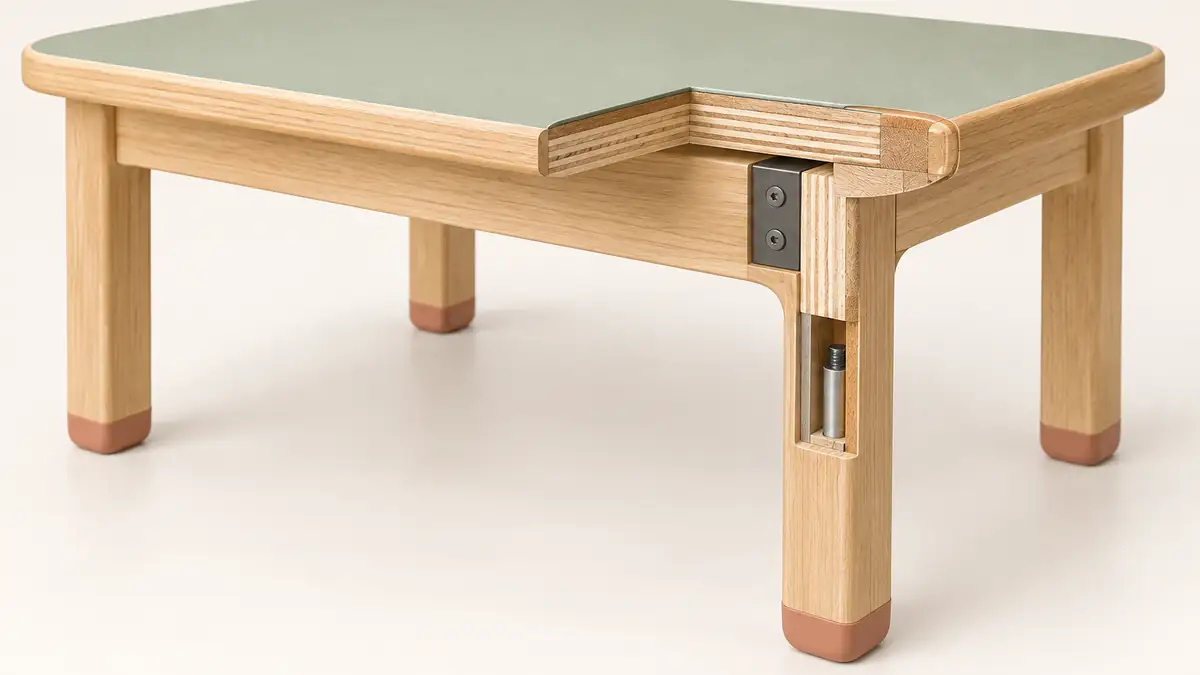
The core and the exposed surface solve different problems. A surface may need to resist fingerprints, paint, water, or frequent wiping, while the core and joints must keep the unit stable. You should assess both. A beautiful wood finish is not enough if the edges swell after repeated cleaning or if damaged parts cannot be replaced.
Treat finish and adhesive as separate decisions
FSC certification does not tell you whether a finish or adhesive meets your local indoor-air, chemical, or education-sector requirements. Ask for the applicable technical information and cleaning instructions for the exact finish.
For younger classrooms, inspect the areas children touch most: front edges, corners, chair backs, handles, shelf lips, and table undersides. Smooth contact areas and sealed edges matter because these surfaces receive repeated contact and cleaning, not just because they look better in a product photograph.
Check construction for repair, not only first use
Classroom furniture is moved, stacked, wiped, opened, and reconfigured far more often than residential furniture. Check how the legs, frames, doors, hinges, handles, shelves, and connectors are assembled.
You should be able to answer three practical questions:
- Which part is most likely to wear first?
- Can that part be tightened, replaced, or refinished without discarding the complete unit?
- Can you still obtain the relevant hardware or replacement component later?
This repair view is especially useful for tables, chairs, open storage, cubbies, art units, and dramatic-play furniture because a small failed component can affect the usefulness of the whole area.
Check fit as a system
Sustainable furniture that does not fit the children or the room will not remain useful. Match chair seat height to table height, leave usable knee and leg space, check reach to storage, and confirm that the furniture footprint preserves clear movement and supervision lines.
Use the Guía de compra de sillas preescolares when you need to compare seating details, then check the complete room through daycare floor plan ideas. The environmental benefit is stronger when the furniture stays in service because it works in the room, rather than being replaced after a layout or sizing mistake.
Match Sustainable Choices to Classroom Zones
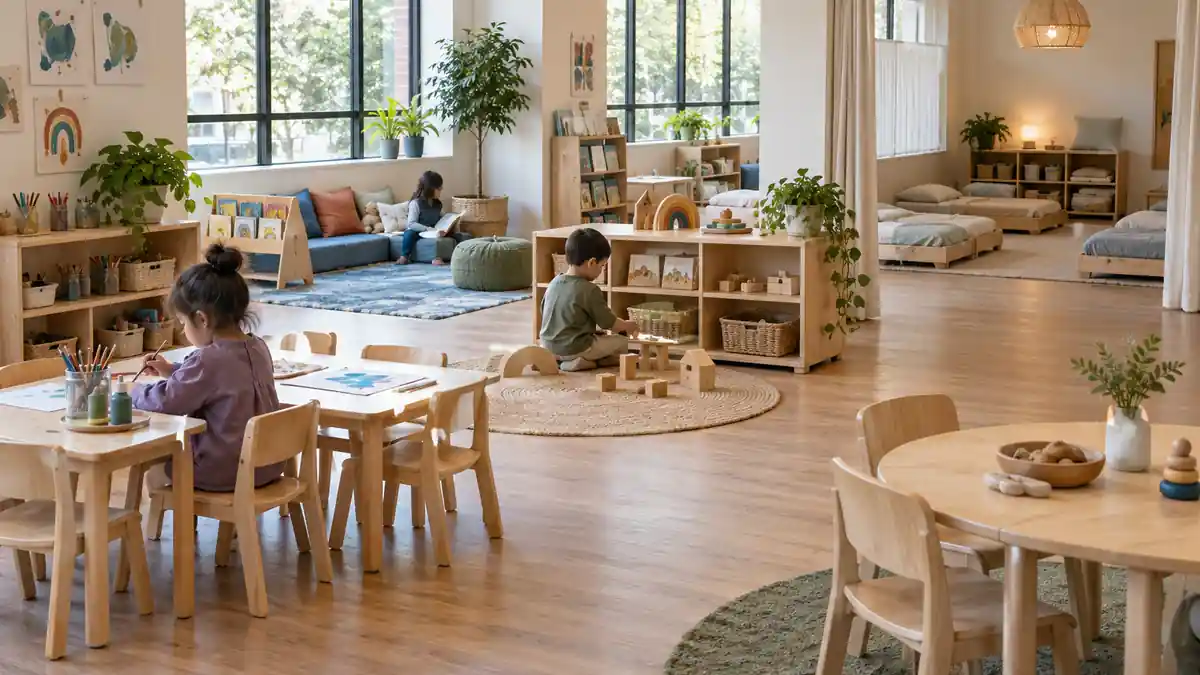
You should not apply one material decision to every area of a preschool or daycare. The activity changes the stress placed on the furniture, the cleaning routine, and the type of repair that matters.
Use the same room-level thinking when you plan a larger project: soluciones para el aula should connect furniture selection with age groups, capacity, movement, storage, and supervision.
| Classroom zone | What you should prioritize | Why the decision is different |
|---|---|---|
| Mesas y sillas | Matched dimensions, stable joints, smooth edges, wipeable surfaces, and replaceable hardware. | Repeated sitting, pushing, lifting, and table movement test the structure every day. |
| Art area | Cleanable work surfaces, sealed edges, durable storage access, and finishes suited to frequent wiping. | Paint, water, glue, and tools create more surface and edge stress than quiet reading. |
| Open storage and cubbies | Stable construction, accessible shelf height, strong handles or hooks, and a layout that supports supervision. | The unit is opened repeatedly and becomes part of the room’s circulation pattern. |
| Reading and quiet areas | Repairable frames, comfortable contact surfaces, stable low shelving, and materials that remain easy to maintain. | A calm space still receives daily use, but its main requirement is long-term comfort and organization. |
| Dramatic-play areas | Secure connections, smooth touch points, clear access, and components that can be changed without rebuilding everything. | Children interact with the furniture from several directions and often move props in and out. |
| Care and nap areas | Cleanability, inspection access, stable support, and clear separation from other classroom activities. | Hygiene routines and repeated cleaning make surface condition and maintenance access more important. |
This zone-based approach also helps you avoid over-specifying. You can reserve the most demanding surface and edge requirements for wet, messy, or high-contact areas instead of applying the same construction everywhere without checking how each room will operate.
Create a Buying Record You Can Check Later
Before you approve the order, keep one concise record for each furniture group. This protects you when a custom change, replacement, or reorder happens later.
| Record to keep | What to confirm |
|---|---|
| Material schedule | The forest-based components, non-wood components, surface, core, finish, and hardware. |
| FSC evidence | Certificate code, certificate scope, FSC label type, and the product or material covered by the claim. |
| Approved drawing | Overall dimensions, critical clearances, storage openings, edge details, and any custom changes. |
| Maintenance instructions | Recommended cleaner, moisture limits, parts to inspect, and the surfaces that need special care. |
| Replacement plan | Common wear parts, available hardware, and the process for ordering a replacement component. |
| Packing information | Protection for corners, surfaces, doors, and assembled joints during transport and installation. |
Keep the record attached to the product name or room zone, not only to a general project folder. When a classroom changes age groups or a storage unit moves to an art area, you can quickly see whether the original furniture still suits the new use.
Use this record as an approval gate. If the material claim, complete specification, approved drawing, maintenance instructions, or replacement plan is missing, pause the order long enough to identify the gap.
Preguntas frecuentes
- Can you describe an entire classroom as FSC-certified because it contains FSC-certified furniture? No. An FSC claim applies to an eligible product or forest-based material covered by the documented claim. Describe the specific furniture items or components instead of extending the certification to the whole room.
- Does the FSC status of a furniture item automatically carry over to a later reorder? No. Before reordering, check that the supplier’s certificate is still current, the product group is still covered, and the new order uses the same claimed specification. A previous order is useful evidence, but it does not replace a current check.
- Does FSC certification automatically include the packaging used to deliver the furniture? No. Furniture and packaging can have separate material claims. If packaging certification matters to your project, ask for its own claim and documentation rather than assuming it follows the furniture.
Conclusión
The strongest eco-friendly classroom furniture decision combines verified forest-based sourcing with a complete specification, safe and maintainable construction, correct classroom fit, and a realistic repair plan. FSC certification gives you an important piece of evidence, but you should still assess the whole furniture system and the way you will use it.
For classroom furniture selection, room planning, customization, and production support, you can continue with Xiair World.