
 Vietnamese
 English
 Arabic
 French
 Italian
 German
 Spanish (Spain)
 Thai
 Japanese
 Turkish
 Indonesian
 Polish
 Portuguese
 Malay
 Swedish
 Spanish (Mexico)
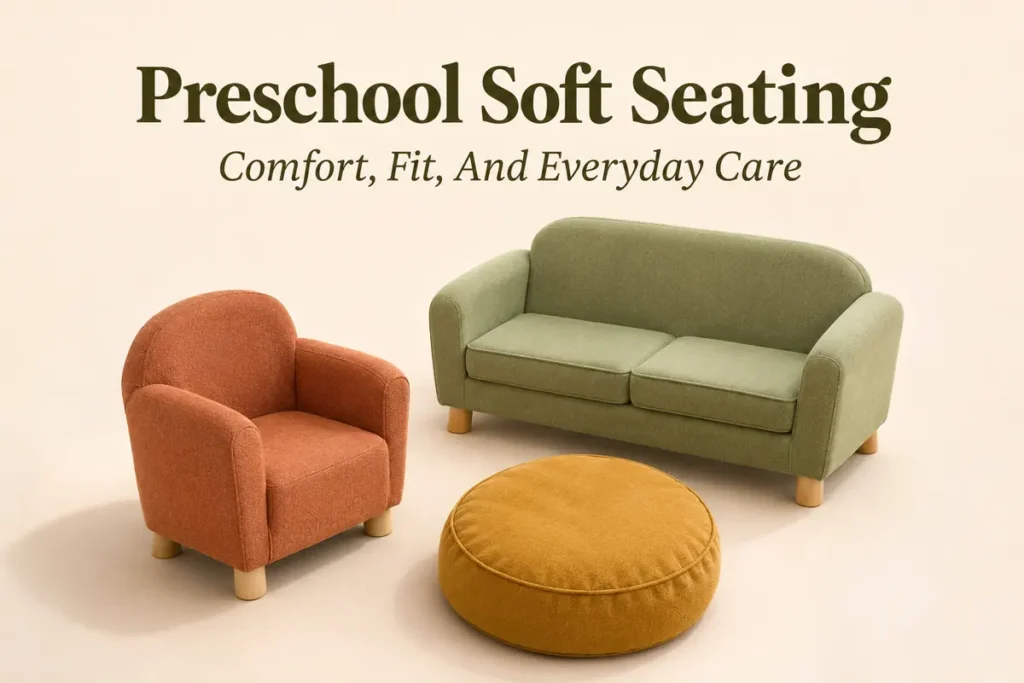
Choose preschool soft seating around the activities in your room, from pretend play to small-group conversations. The seat needs to suit the task as well as the available space, and its cover needs to fit your cleaning routine.
Preschool Soft Seating In Learning Areas
You do not need the same seating in every corner. Think about whether you want to share a book, act out a story, handle materials, or offer somewhere to pause. For the wider arrangement of activity zones, see the guide to setting up learning centers.
Reading And Listening
In a reading corner, place a small sofa or padded bench where you can share an open book without squeezing against an armrest. For individual listening, you might use separate padded chairs angled toward the story or audio source. Keep the books within reach of the seats so choosing another book does not mean crossing through the group.
Giả vờ chơi
In a khu vui chơi kịch tính, a child-sized sofa can become the living room in a pretend home or the waiting seat in a pretend clinic. Pair it with the props that make that setting clear. Choose a compact shape so there is still room to dress up, carry a doll, or move between the kitchen and sitting area. If you change the theme often, a simple bench may fit more settings than a large corner sofa.
Quiet And Sensory Spaces
For a góc bình yên, offer a place to sit alone as well as room for support nearby. Try the cover texture and amount of sink with the intended users; a smooth, supportive seat and a deep, fabric-covered cushion can feel very different. Keep a choice available rather than assuming that everyone will prefer the softest option.
You can use ACECQA’s guidance on inclusive environments to review quieter spaces and different participation needs. A soft seat is one possible furnishing for that space, not a treatment or a promise of calmer behaviour.
Blocks, Puzzles, And Discovery
Along the edge of a construction area, you could use a low padded bench as a place to discuss a model or look through plans. Keep the building surface separate: blocks and puzzle pieces need a steady base, not a sinking cushion. For a discovery corner, you can pair preschool chairs with a suitable table for magnifiers, specimens, or sorting trays. Check the reach to that table while seated so the activity does not require constant leaning forward.
Small Groups And Storytelling
Arrange a few separate seats in an open arc for puppets, conversation, or sharing work. You can face the same display without committing to a long sofa. Floor cushions may suit a temporary group that uses the floor afterwards; backed seats may suit a group that stays seated longer. For music with movement, put the seats at the edge rather than in the space used for dancing or instruments.
Sofas, Benches, And Floor Cushions
Once you know the activity, compare the actual seat designs. The names in a catalogue do not tell you how much usable space or support you will get.
| Seat Type | What You Get | What To Look At |
|---|---|---|
| Small sofa | You have a shared sitting surface within one frame. | You need room for the whole frame, including arms; overall width is not usable seat width. |
| Padded armchair | You have an individual seat with a back and arms. | You use more floor space per place than with some shared benches. |
| Padded bench | You have a continuous padded sitting surface. | You may have no back support, depending on the design. |
| Floor cushion | You sit close to the floor on a separate pad. | You need storage for the cushions and a suitable alternative for anyone who cannot comfortably get down to the floor. |
| Modular foam seat | You combine separate sections, with or without backs and arms. | You may need additional pieces to provide the back or arm support shown in a set photograph. |
If you are considering beanbags, compare the changing shape with a seat that holds its form. You may find getting up from a deeply sinking seat harder than from a supported cushion. Soft seating and flexible classroom seating overlap, but you do not need a fully flexible seating programme to add a few comfortable places.
Space And Seating Numbers
Mark the full footprint on the floor before ordering, including arms and curved backs. Leave room in front for getting up and alongside for approaching the seat. If you need wheelchair access or support with transfers, review the arrangement and seat choice with the relevant specialist rather than assuming a low sofa will suit everyone.
For modular seating, draw the complete arrangement you intend to use. Include any spaces between modules and check the manufacturer’s connection details. Follow the Texas Education Agency guidance on classroom arrangement: preserve a clear view of children and separate quiet activities from noisy ones. A high sofa back or a new group of seats should not create a hidden corner or interrupt a route.
For quantities, count how many places you need at the same time. A small reading group does not necessarily need a soft seat for everyone enrolled in the room. Keep the rest of the floor available for the activities you already run.
Seat Height, Depth, And Support
You cannot judge fit from the age label or overall sofa height alone. Ask for the usable seat measurements and, where possible, try a sample with the intended age group under supervision. For an upright chair or sofa, look for comfortable foot support, a backrest you can reach without sliding backwards, and an easy way to stand up.
Seat Measurements
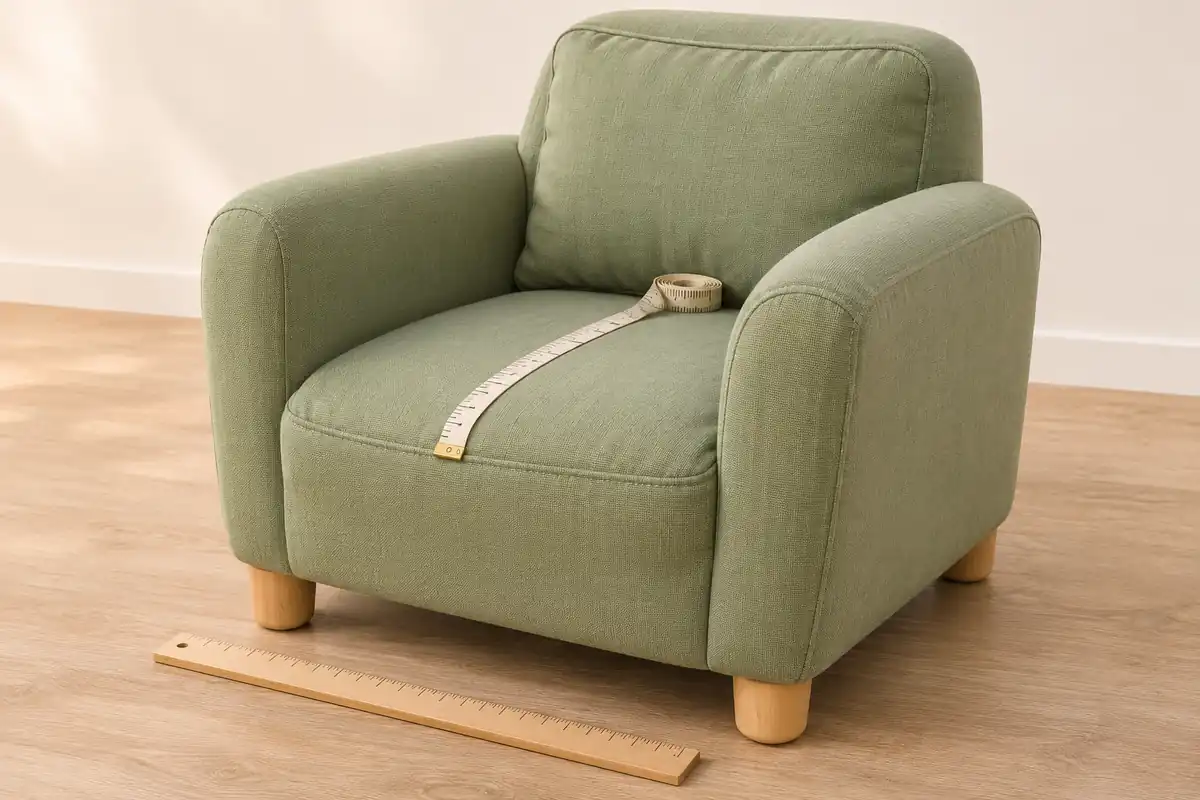
Use the measurements below when comparing products. These are checks to make on a sample, not a universal size chart: a padded seat changes under weight, and children of the same age differ in size.
| Đo lường | What To Confirm |
|---|---|
| Seat height | Measure from the floor to the sitting surface. Check how far it compresses in use, rather than relying only on the unloaded height. |
| Usable seat depth | Measure from the front edge to the face of the back cushion. Look for room to bend the knees without having to slide away from the backrest. |
| Usable seat width | Measure between the arms or other raised edges. Confirm the intended number of users rather than estimating capacity from a photo. |
| Back and arm height | Check support and access from the actual sitting position. Deep arms can make a small seat harder to enter from the side. |
Cushion Fit And Support
Press the centre and front edge of the cushion, then release it. On a sample, look for even support, recovery of shape, and no obvious contact with a hard frame through the padding. This gives you a practical comparison; it does not replace the product’s testing or load limits.
For removable cushions, confirm three sets of dimensions: the space in the seat frame, the foam insert, and the finished cover. Include corner shapes and thickness. A cushion with the right width can still bunch up, leave gaps, or sit too high if the other details do not match.
Covers And Cleaning
Choose the cover around your actual cleaning routine. A removable fabric cover and a wipeable coated cover involve different work. Neither description tells you the full cleaning method.
Wipeable Covers
Ask which cleaning and disinfecting products the exact covering can tolerate, including the required dilution and contact time. A surface described as water-resistant is not automatically suitable for every disinfectant. Look closely at stitching, piping, folds, and the underside, where spills may reach beyond the visible sitting surface.
Removable Fabric Covers
Confirm whether you can machine-wash the cover, how to dry it, and whether it can be put back on without stretching the seams. Plan where you will keep the seat while its cover is being cleaned. If it will be out of use for a full day, a spare cover may be more useful than an extra decorative cushion.
Follow the manufacturer’s instructions alongside the CDC cleaning guidance for early care settings. Clean before sanitizing or disinfecting when those steps are needed, use products appropriate for the surface, and dry washable items completely. Follow any additional requirements that apply to your setting.
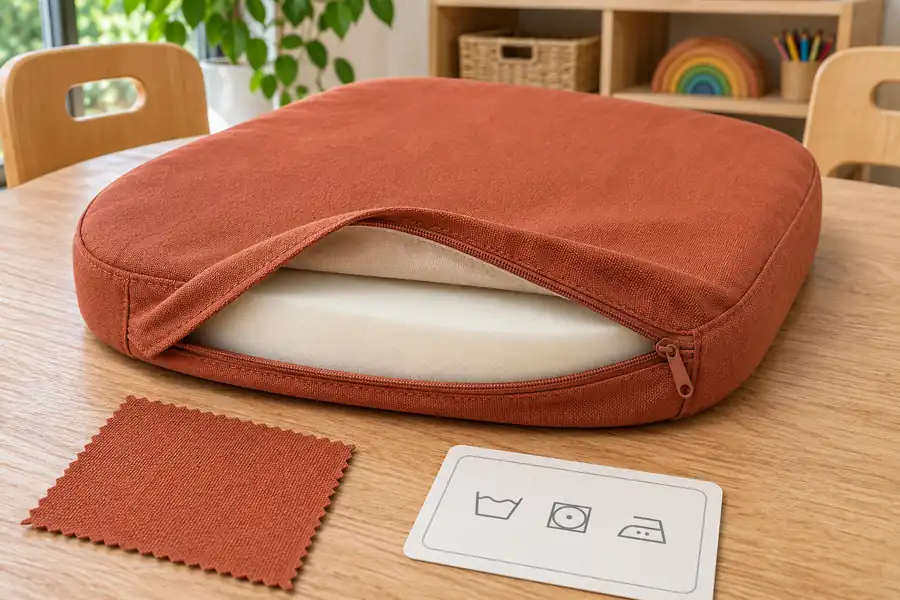
When comparing samples, try the approved cleaning method on a material swatch first. Check for colour transfer, a sticky feel, peeling, or a change in texture. A swatch test can reveal an obvious mismatch with your routine, although it cannot prove years of durability.
Seams, Zips, And Product Documents
Look beyond the outside fabric. You need intact seams, secure parts, a stable base, and filling that stays enclosed. Check the maker’s intended use: a padded seat is not automatically climbing equipment just because it resembles a soft play block.
For bead-filled beanbags, pay particular attention to access to the filling. In Australia, the mandatory beanbag standard includes child-resistant fasteners and warning requirements. Confirm the rules for your own market and the specific product. Do not use a seat with escaping filling or a damaged closure.
Request documents that identify the model and the covering and filling supplied. For the US, review the CPSC requirements for upholstered furniture, including applicable flammability requirements and additional children’s-product requirements. A report for one material is not proof that every sofa or every custom combination meets all relevant requirements. Agree on the destination market before production rather than accepting a general “certified” claim.
Price, Spare Parts, And Delivery
Compare quotes for the same finished size, cover specification, filling, and included pieces. Check whether a photographed set includes every cushion and backrest shown. Include spare covers, replacement inserts, freight, and any assembly in the comparison.
Ask how the furniture will arrive. A fully assembled sofa may need more delivery space than a boxed foam unit. Measure the delivery route as well as the final room, and confirm whether vacuum-packed foam needs time to regain its shape under the supplier’s instructions.
Before approving a larger order, confirm which parts can be replaced separately and how those parts will be identified. A replaceable cover is only useful if you can obtain the right shape and fastening arrangement later. Keep the model reference and approved specifications, not just a sales photo.
Câu hỏi thường gặp
- Will A Home Furniture Warranty Cover Classroom Use?
Ask for written confirmation before buying. You may find that a domestic warranty excludes shared or commercial use. Check what is covered for the frame, cover, and filling, and what evidence you would need for a claim.
- Can You Sit On A Child-Sized Sofa With A Child?
Only if the stated load and intended use allow it. Confirm whether the limit is for the complete sofa or each seating place. Do not judge adult suitability from the seat width.
- Can You Use Indoor Soft Seating Outside?
Only when the manufacturer permits that use. A wipeable indoor cover does not establish resistance to sunlight, rain, or outdoor storage conditions. Check the whole product, including the frame and filling.
- Do All The Seats Need To Be The Same Colour?
No. You can coordinate a few colours without buying a complete matching set. Approve actual material samples together in the room; the same colour name on two different fabrics may not look the same. Keep the agreed sample as your reference.
- Is Second-Hand Soft Seating Worth Considering?
First check that you can identify the manufacturer and model, check for recalls, and obtain the product history. Be cautious when you cannot tell whether the filling or cover has been replaced. You may be unable to establish which specifications still apply.
Phần kết luận
If you need help matching sizes, covers, or replacement parts, Thế giới Xiair can review the options with your room dimensions and intended use.