
 Arabic
 English
 French
 Italian
 German
 Spanish (Spain)
 Thai
 Japanese
 Turkish
 Indonesian
 Vietnamese
 Polish
 Portuguese
 Malay
 Swedish
 Spanish (Mexico)

When choosing preschool rugs and floor mats, start with what you need each product to do: group seating, play, exercise, naps, changing, or keeping dirt at the entrance. You need different features for each use, even when two products look alike. Compare the size, material, construction, storage, and care instructions before choosing a color or pattern.
What Is The Difference Between A Rug And A Mat?
With a rug, you are usually choosing a separate textile floor covering with a woven or tufted surface. With a mat, you need a more specific name to identify the product: entrance mat, foam play mat, exercise mat, rest mat, or changing mat. You can buy mats made from textiles, rubber, foam, or padding inside a cover.
You will see some overlap in the names, especially for small textile floor coverings. Do not assume that every mat is foam or every rug has a particular shape. Compare the material, construction, and intended use on the product sheet.
Treat “folding,” “interlocking,” and “roll-up” as construction details, not separate uses. You may find both a folding activity mat and a folding nap mat, but you cannot assume either can replace the other. Choose by the stated purpose first.
Which Rugs And Mats Do You Need?
Choose across the full range of rugs and mats used in preschool rooms. Use the product’s purpose to narrow your options, then compare the details that matter for that job.
| نوع المنتج | Where You Would Use It | What To Compare |
|---|---|---|
| Classroom rugs | Group time, reading, and building areas | Compare round, rectangular, and oval shapes. Try a block tower or toy vehicle on a sample if you need a surface for building. |
| Foam play mats | Floor play and supervised movement | Choose a continuous mat or interlocking tiles. With tiles, check whether you can order matching replacements, including the same connector shape. |
| Rest and nap mats | Preschool naps and scheduled rest | Check the stated age range and sleep use. Compare fitted-sheet options and whether you can identify each mat without marking the sleeping surface. |
| Exercise and yoga mats | Stretching, balance, and guided movement | Try the movements you plan to teach. Check whether you can keep a steady hand or foot position without sinking into the surface. |
| Changing mats | Your changing station, if you provide this care | Choose a model approved for your changing table or unit, including the specified way to secure it. Do not rely on raised sides to prevent a fall. |
| Entrance mats | Doorways leading in from outdoors | Compare dirt-scraping and moisture-absorbing surfaces. Open the door fully over the sample. |
| Protective floor mats | Art, water, and meal areas where your floor needs protection | Check whether you can move chairs freely. You may need no extra covering if your existing washable floor already suits the activity. |
You can compare seating, reading, and plain designs in the classroom rugs collection. Choose a rug for the activity you plan, rather than treating every soft surface as interchangeable.
For climbing equipment, choose the protective surfacing specified for that equipment and its fall height. Do not treat a soft play mat, a classroom rug, or a thicker underlay as proof of fall protection.
What Size Do You Need?
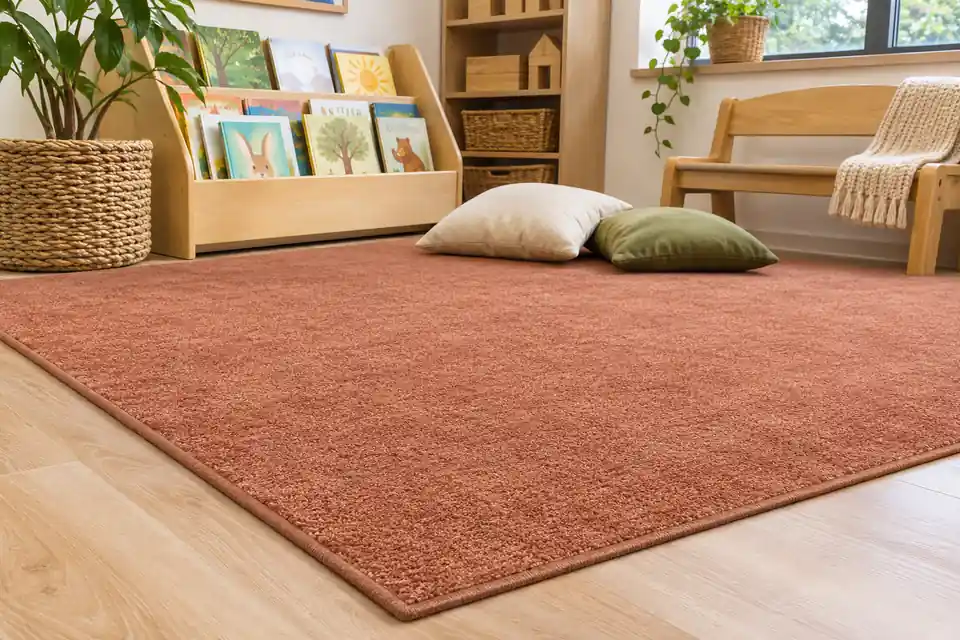
Measure the activity area after you place the shelves, tables, and chairs. Include space to pull chairs out and open storage doors. Keep your required exit and accessible routes outside the loose floor covering wherever your layout allows, while preserving access to the activity itself.
Use removable floor tape to mark a candidate rug size. For a classroom reading corner, try the outline with books open and an adult seated beside a child. For group time, check the actual sitting arrangement instead of relying only on the number of printed spots.
Compare the outline as well as the stated dimensions. With a rectangular rug, you can use the corners for rows or building. With a round or oval rug, you lose those corners. For example, a 2 m diameter circle gives you about 3.14 m², compared with 4 m² for a 2 × 2 m square. Neither measurement tells you a seating capacity by itself.
A Size Example For Group Time
For an initial sketch for 12 children, you could draw three rows of four trial seating boxes, each 60 × 60 cm. That gives you a 2.4 × 1.8 m seating rectangle. Adding a 60 cm strip at the front for your story materials gives you 2.4 × 2.4 m before you allow for any other space.
Use those numbers only to test a layout, not as a seating standard or capacity claim. Adjust for your actual group, sitting positions, adult participation, and mobility needs. If you are comparing a 2 × 3 m rug with a 2.4 × 3 m rug, the narrower option would not fit that four-seat row as drawn, even though it looks long enough in a photograph.
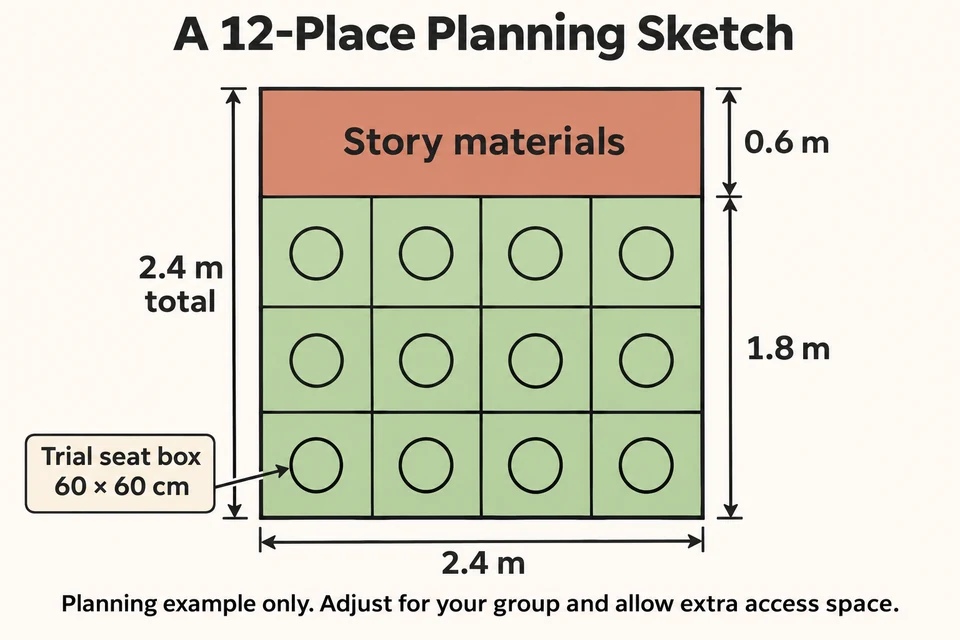
For a true circle arrangement, mark the circle separately. You cannot carry over the capacity from a rectangular row plan. When working through quiet and active areas, also check whether anyone needs to cross the rug to reach another activity.
Size Individual Mats For The Whole Activity
For a rest mat, compare the usable sleeping length and width with your age group and the bedding you will use. Leave room for a comfortable lying position instead of choosing by height alone. Lay out the full number of mats, with the spacing required by your local childcare rules, before deciding how many fit in the room.
For exercise mats, test more than a standing position. Allow for reaching, kneeling, and lying down without moving onto the next mat. For a changing mat, compare its full outside dimensions with the usable top of your changing unit; include raised sides and any required fittings.
Look Beyond How Soft It Feels
Compare the top surface, backing, and edges separately. You may like the feel of a thick sample in your hand but find it too soft for blocks, chair legs, or wheeled equipment. For an everyday preschool rug, a short, dense pile is a useful starting point because you can see small play pieces and inspect the surface more easily.
Rug Fibers And Construction
When comparing nylon, polypropylene, polyester, or wool, ask for the exact fiber content and construction. You cannot judge the finished rug from the fiber name alone. Compare the density, how easily the pile separates, the strength of the binding, and the cleaning instructions for the whole product.
Confirm those details for each shape and size you order. You may be offered a round rug and a rectangular rug with a similar color but different fibers, backing, or care instructions.
- For a frequently used group rug, ask for a commercial-use wear specification and a sample. Rub the pile in several directions and check whether the surface recovers after pressure.
- For a washable textile rug, confirm whether you can wash the complete rug or only a removable cover. Include the backing in that question.
- For wool or other natural fibers, check the permitted detergents and cleaning methods before choosing them for a room with frequent spills. Do not use “natural” as a substitute for product information.
Foam Mats And Wipeable Covers
For an EVA or PE foam mat, compare firmness as well as thickness; the same thickness can feel different with different foam. With interlocking tiles, examine the joints and removable border pieces. Do not use the thickness of a soft-play block as a floor-mat specification.
For a padded mat with a coated cover, inspect the seams, corners, and any zipper or closure. A wipeable top does not tell you whether liquid can enter at a stitched seam. Ask whether you can replace a damaged cover. For folding models, lay the mat open and check the hinges for gaps or raised sections.
Will It Fit When You Put It Away?
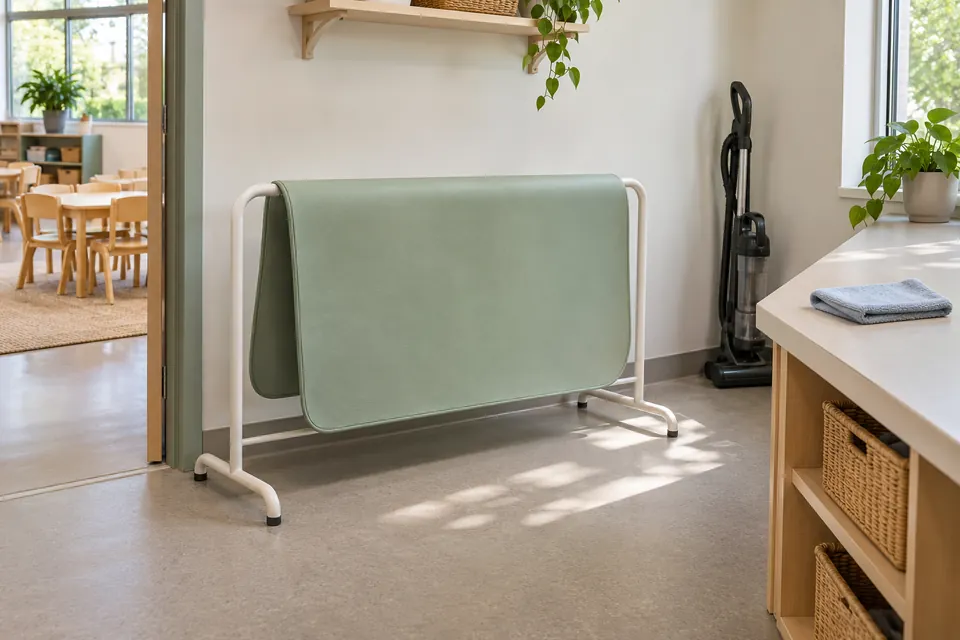
Measure the cabinet’s usable internal width, depth, and shelf opening, including hinges or dividers that narrow the space. Compare those measurements with the mat’s stored dimensions: folded length, folded width, and folded thickness, or roll length and diameter. Your cabinet’s outside dimensions cannot tell you whether the mat will fit.
For flat stacking, calculate the whole stack. Ten mats at 3 cm each give you a nominal 30 cm stack; at 5 cm each, the same quantity gives you 50 cm. These are arithmetic examples, not recommended thicknesses. Add space for covers and your hands, then confirm the actual stack height without squeezing the mats into the opening. For nap mats, also allow for your required bedding storage and keep sleeping surfaces away from floor-contact surfaces.
For folding mats, use the folded measurements supplied for that model, including the cover and hinges. Do not assume that a two-fold or three-fold mat becomes exactly half or one-third of its open length.
Check The Backing On Your Actual Floor
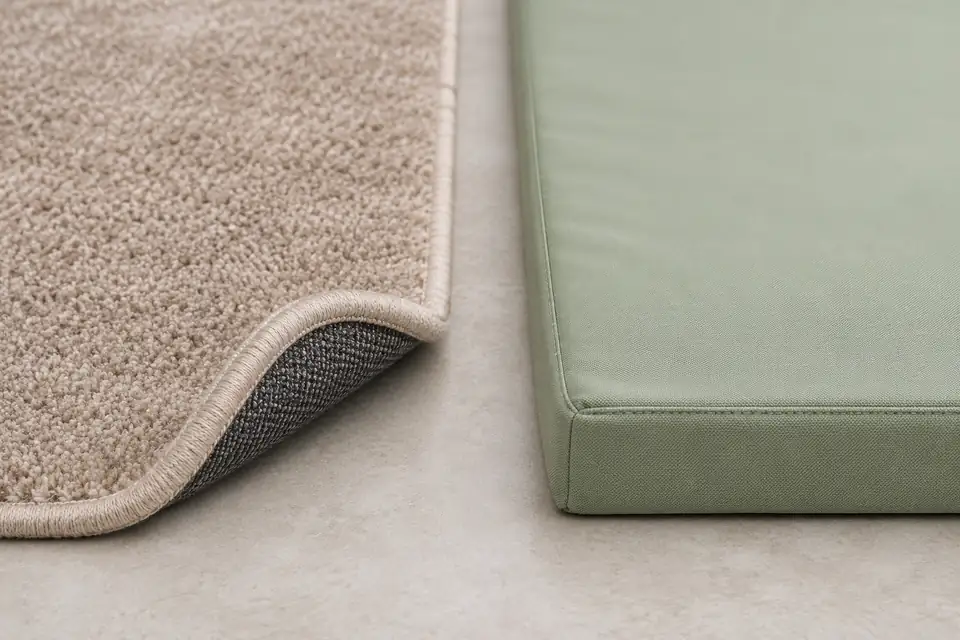
Try a sample on the same floor finish you use in the classroom. Check whether it slides, bunches when pushed, or lifts at the corners. Ask both suppliers whether the rug backing or underlay is compatible with your flooring; a grip layer that works on one finish may be unsuitable for another.
Check the complete thickness at the edge, including any underlay. Keep table or shelf legs fully supported on a consistent surface. Avoid placing half a furniture base on a thick mat and half on the bare floor.
If you need an arch or another cut shape, confirm how the edges will be finished before ordering. For a textile rug, ask for the new edge to be bound or finished as specified. For a covered foam mat, cutting may open the cover and expose the filling. Cut on site only if the manufacturer permits it for that exact construction and provides the finishing method.
For US projects where ADA requirements apply, use the US Access Board guidance on floor surfaces to check firmness, carpet attachment, edge treatment, and changes in level. You should not use its ½-inch maximum carpet pile height as a general recommendation for foam-mat thickness. For other locations, check the applicable accessibility requirements for your room.
Choose A Pattern You Will Actually Use
You do not need a round rug or a clock design just because you call the activity circle time. Choose marked seating when you want visible places for group sitting. Choose an open design when you want to rearrange the group or use the same area for building and storytelling.
If you plan to teach with letters, numbers, roads, or maps, inspect the artwork at the size you will order. Check spelling, sequence, language, and whether you can read the details from the intended sitting position. A busy print can make small puzzle pieces harder to find, so try your everyday materials against the sample.
Confirm the color with a physical swatch when matching rugs to furniture. A room rendering may use an approximate texture, and your screen cannot confirm the finished shade. If you want matching rugs or mats across several rooms, approve the products together and record each color reference; “beige” alone will not identify a consistent shade across different materials.
Choose A Cleaning Method You Can Keep Up With
Read the care label for the product you need. “Easy to clean” means different work for a textile rug, a foam play mat, and a changing mat: vacuuming, spot cleaning, machine washing, extraction cleaning, or wiping with a suitable product.
For soft surfaces, follow the CDC guidance for early care and education settings: use suitable cleaning products, vacuum rugs, and follow the manufacturer’s laundering instructions where washing is allowed. Dry washable items completely.
- Check your laundry capacity. Confirm that the rug fits your machine and that you have a practical way to dry its full size.
- Check access underneath. Make sure you can lift the covering to inspect and clean the floor without dismantling the whole activity area.
- Match the cleaning product to the surface. Confirm compatibility, required contact time, and any rinsing instructions when sanitizing or disinfecting is needed.
- Allow for drying time. Decide where the activity will take place while the covering is out of use. Do not return a rug with a damp backing or fold a wet mat into storage.
For a changing mat, follow the CDC diaper-changing steps, including cleaning and disinfecting the surface after each use. For nap mats, plan separate care for bedding and the covered mat, following your setting’s hygiene requirements. You cannot use a rug-vacuuming routine for either task.
Ask your cleaning team to review a sample and its care sheet. You can then check whether the chosen product fits the equipment, supplies, and time you have.
Know What The Product Documents Cover
Ask for documents that identify the exact product, backing, and intended use. For a US rug purchase, use the CPSC carpet and rug guidance to discuss the applicable surface-flammability requirements and certification with your supplier. Do not apply rug documentation automatically to a foam play mat, rest mat, or changing mat. Confirm the requirements for each product type with your supplier and local licensing or fire authorities.
Keep emissions testing separate from fire testing. If you request a low-emissions product, ask for a current listing that covers the item you will receive. For example, you can use UL GREENGUARD certification information to understand chemical-emissions testing; you cannot use that certification to establish slip resistance or fall protection.
For a custom size or print, confirm whether the supporting documents still cover the finished version. Keep the approved dimensions, fiber or foam type, backing, artwork, and care sheet together so you can compare the delivered item with what you selected.
الأسئلة الشائعة
Can You Put A Preschool Rug Over Existing Carpet?
Check whether the rug and any required underlay are intended for carpet-on-carpet use. You may get creeping or ripples over a soft base. If you cannot keep the extra layer flat and secure, use the existing carpet and define the activity area with your furniture instead.
Can You Use An Indoor Classroom Mat Outdoors?
Use it outdoors only when the manufacturer permits that use. You need information about sunlight exposure, moisture, drainage, and storage. A wipeable indoor cover alone does not establish outdoor suitability.
When Should You Replace A Rug Or Mat?
Take it out of use when you find persistent curling, loose binding, exposed foam, a split cover, or a backing that sheds or no longer grips. Ask whether an approved repair is possible. If you cannot restore its condition or clean it properly, replace it instead of relying on a fixed number of years.
خاتمة
Through عالم شياير, you can review your rug and mat choices alongside your furniture plan, including the storage needed when the room changes use.