
 Arabic
  English
  French
  Italian
  German
  Spanish (Spain)
  Thai
Thai  Japanese
  Turkish
  Indonesian
  Vietnamese
  Polish
  Portuguese
  Malay
Malay  Swedish
  Spanish (Mexico)
Preschool nap time looks simple on a daily schedule, but in the classroom, it involves more than deciding when children should sleep. Age, sleep needs, classroom size, available storage, staff routines, and local childcare rules can all affect how nap time works.
An infant room may use cribs, while a toddler room may use cots or mats. Some centers have a separate sleep room, while others need to turn the same classroom from a learning space into a rest area every afternoon. A good nap plan should therefore work for both the children and the staff who set up, supervise, clean, and store the equipment every day.

Why Is Nap Time Important in Preschool?
Children use a lot of physical and mental energy during the day. A planned rest period gives them time to slow down and recover before afternoon activities.
Enough rest can support better mood, attention, behavior, and participation. Children who become overtired may find it harder to manage emotions, follow routines, or stay focused during group activities.
However, nap needs change as children grow. Younger children usually need more daytime sleep, while some preschoolers may no longer fall asleep every day. This is why a preschool nap routine should leave room for different sleep needs instead of expecting every child to follow exactly the same pattern.
How Should Preschool Nap Time Be Scheduled?
A good nap schedule should fit the children’s age and the rest of the daily program. You do not need to make every classroom follow the same clock. It is to create a routine that children can recognize and staff can manage regularly.
How Long Should Children Nap?
Sleep needs are different by age and by child.
Infants usually sleep several times during the day rather than following one fixed afternoon nap. Their sleep schedule often needs to be more flexible.
الأطفال الصغار commonly move toward one main daytime nap. A rest period of around one to two hours is common, although kids need different.
Preschoolers may still sleep for around one hour or longer, while some children may only need quiet rest. Older preschoolers are also more likely to stop napping regularly.
Instead of forcing every child to sleep for the same amount of time, teachers should consider the child’s age, energy, nighttime sleep, and behavior throughout the day.
What Time Should Nap Start?
Many preschools and daycares place nap time after lunch.
Lunch, Bathroom or diapering, Quiet transition, Nap
This gives children time to move gradually from active classroom routines into rest.
Example Preschool Nap Time Schedule
| وقت | نشاط |
|---|---|
| 11:30–12:00 | غداء |
| 12:00–12:20 | Bathroom, diapering, and clean-up |
| 12:20–12:30 | Quiet story or transition |
| 12:30–2:00 | Nap or rest time |
| 2:00–2:15 | Gradual wake-up and room reset |
| 2:15 onward | Snack and afternoon activities |
This is only an example. The actual schedule should match the children’s age, the center’s program, and local childcare requirements.

How to Prepare the Classroom for Nap Time
The classroom should be easy to change from active learning to rest without creating extra work for staff. Some centers use a sleep room, while others set up cots or mats in the regular classroom. The right setup depends on the age group, available space, and how the room is used during the rest of the day.
Before nap time, make sure there is enough space for all sleeping equipment while keeping doors, teacher access, and main walking paths clear. Reduce noise and bright light where possible, and use familiar routines such as a short story or quiet music to help children settle.
For classrooms that are used for both learning and sleeping, also consider what happens after nap time. Cots or mats should be easy to remove so staff can return the room to normal use without moving furniture.
Choosing the Right Sleep Equipment
Cribs, cots, and nap mats serve different age groups and classroom needs. You will find that several age groups may need more than one type of sleep equipment.
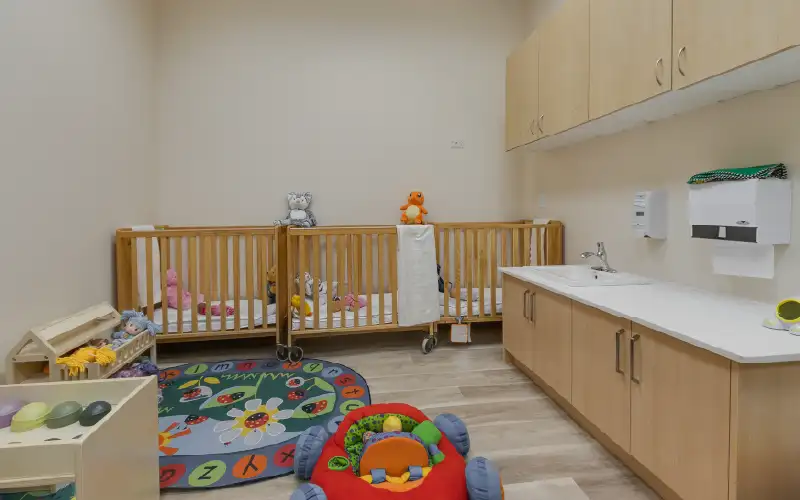
Cribs for Infants
If you are planning an infant room, you will usually need cribs rather than standard nap mats or cots. Because cribs are used for younger children, you need to pay closer attention to product structure and the safety requirements of your target market.
- the age and size of the children
- the spacing between rails and other openings
- mattress size and fit
- overall crib dimensions
- stable construction
- access for staff
- wheels and locking systems if used
- the space needed around each crib
Rail spacing is especially important when you are importing cribs. Different countries and markets may set different limits for the distance between crib rails and other openings. A crib design that meets the requirements in one market may not automatically be suitable for another. For the U.S. market, for example, CPSC guidance states that the spacing between crib slats should not exceed 2 3/8 inches, or about 6 cm.
You should therefore confirm the local crib requirements before you finalize the product design, quantity, and room layout, rather than checking these details after production has started.
Cots for Toddlers and Preschoolers
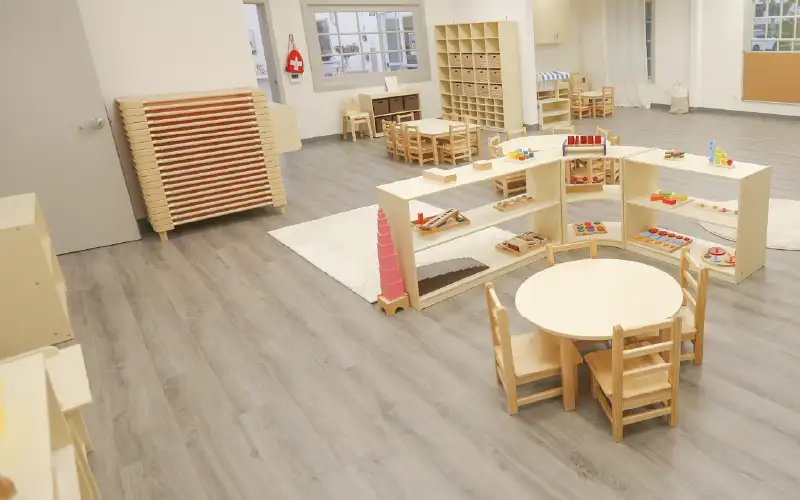
Cots are widely used in daycare and preschool rooms because they provide a raised sleeping surface and can often be stacked after use.
They can work well when you need equipment that is used every day but removed after nap time.
- overall dimensions
- age suitability
- frame strength
- sleeping surface material
- weight
- stacking height
- how easily staff can move them
A stackable cot saves floor space during storage, but the center still needs a suitable place for the full stack.
Nap Mats for Flexible Classrooms
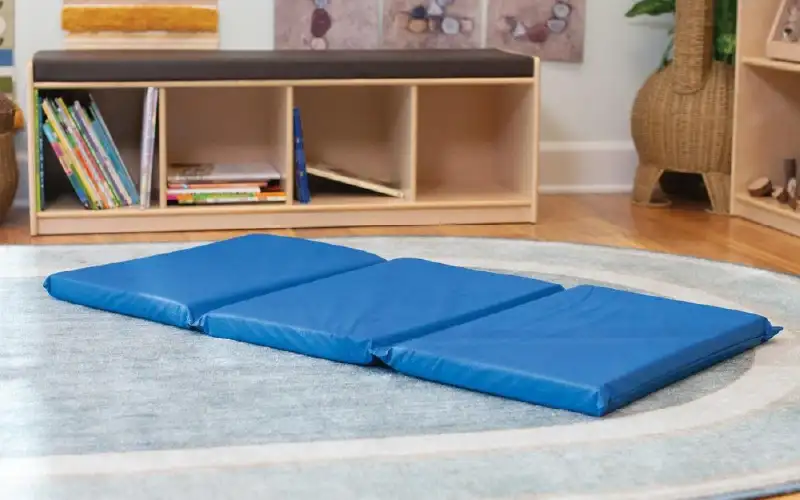
Nap mats are useful when classrooms need a simple sleeping surface that can be moved or stored quickly. Depending on the project, mats may be:
- flat
- foldable
- foam-filled
- fabric-covered
- waterproof or wipe-clean
Different projects also use different thicknesses. 3 cm and 5 cm mats are common in many applications, while some centers request thicker options.
There is no single thickness that is automatically best for every project.
A thicker mat may offer more cushioning, but it also takes more storage space. A fabric surface may feel softer, while a waterproof surface can make daily cleaning easier.
The right choice depends on the room, the children, the floor, the cleaning routine, and the way the mats will be stored.
What to Consider Before Choosing
Before deciding between a crib, cot, or mat, check five things.
- Age: Infant, toddler, and preschool rooms may need different equipment.
- Room use: A permanent sleeping room has different needs from a classroom that must be reset every afternoon.
- مقاس: The product must fit the child and the available floor space.
- Daily handling: Staff should be able to set up and remove the equipment without unnecessary work.
- تنظيف: Materials should suit the center’s normal cleaning and hygiene routine.
The best product is not simply the one with the lowest price or the thickest mattress. It is the one that fits the way the center actually operates.

How to Store Nap Equipment
Storage is often treated as a separate decision, but it should be planned at the same time as the nap equipment.
This becomes especially important in classrooms where mats or cots cannot remain on the floor throughout the day.
Plan Storage Before Ordering
- Where will they go after nap time?
- Will they be stacked, folded, or placed in a cabinet?
- How much space will the bedding need?
- Can staff reach the storage area easily?
- Can the storage unit fit inside the planned classroom layout?
Waiting until the equipment arrives to solve storage can create unnecessary problems.
Match Product Size to Storage Space
This is one of the most practical measurements to check.
A mat can be the right size for a child and still be the wrong size for the classroom if it does not fit the storage cabinet.
For example, a mat may extend beyond the cabinet depth, or a mat storage cart may be too large for the available space.
Before ordering, compare:
- Nap equipment dimensions
- folded or stacked dimensions
- storage internal dimensions
This is especially useful when you already have existing cabinets or a fixed floor plan.
Store Individual Bedding Separately
Nap equipment is only part of the storage requirement. Each child may also have:
- sheets
- blankets
- pillows
- sleep bags
- comfort items
These items should be clearly identified and stored according to the center’s hygiene policy.
Using bins, labeled compartments, cubbies, or dedicated bedding storage can make it easier for staff to keep each child’s items organized.
Make Daily Access Easy for Staff
Storage should not only hold the equipment. It should also support the daily routine.
If staff need to carry 20 mats across several activity areas every afternoon, the storage location may not be practical even if everything technically fits.
Good nap storage should be:
- close enough to the rest area
- easy to access
- simple to clean
- sized for the full quantity of equipment
- positioned so it does not block normal classroom use
This is why nap equipment and classroom storage are often better planned together.

What If a Child Does Not Nap?
Not every preschool child will sleep during the scheduled rest period.
Children who do not fall asleep should not automatically be treated as a problem. Older preschoolers may simply need less daytime sleep.
If a child remains awake, the teacher can provide quiet activities such as books, drawing, simple puzzles, quiet manipulatives, and soft toys. The activity should be calm enough that it does not disturb children who are still sleeping.
If the classroom allows it, a small quiet area can also be used for early wakers or non-nappers. This does not need to become another full activity center. A low shelf, a few books, and simple quiet materials may be enough.

Check Local Nap and Sleep Requirements
Before you finalize your nap setup, check the childcare requirements that apply to your location. Rules can vary by country, state, province, and licensing authority. Depending on your market, requirements may cover:
- spacing between cots, mats, or cribs
- supervision during nap time
- bedding and hygiene
- sleep room setup
- mattress requirements
- age-specific sleep arrangements
If you are importing sleep equipment, confirm these requirements before placing the order. A product that is suitable for one market may not automatically meet the rules in another.
خاتمة
A good preschool nap time plan needs to work before, during, and after children sleep. The schedule should suit the age group, the classroom needs enough usable space, the equipment should fit daily use, and the storage should make setup and clean-up manageable for staff.
For a new preschool or daycare project, it is usually easier to plan these decisions together instead of choosing mats, cots, cribs, storage, and classroom furniture separately.
Xiair World can work from your floor plan, age groups, number of children, and room use to help plan classroom layouts and match suitable cribs, cots, nap mats, storage, and other preschool furniture for the project.
الأسئلة الشائعة
- Can preschool nap mats be customized to fit existing storage?
Yes. Nap mats can be made in different lengths, widths, thicknesses, and folding styles depending on the manufacturer. If a center already has storage cabinets, it is better to check the cabinet’s internal dimensions before ordering. - How many nap mats or cots should a daycare order?
The quantity depends on the number of children who use the room and the center’s licensing requirements. It is also useful to consider whether spare units are needed for replacement, cleaning, or changes in enrollment. - Can different age groups use the same type of nap equipment?
Sometimes, but not always. Infant, toddler, and preschool rooms may have different sleep needs and safety requirements. You should check age suitability before using one product type across several classrooms. - What should be measured before ordering nap furniture?
Measure the usable floor area, doors and access points, planned sleeping space, storage area, and the internal dimensions of any existing cabinets. For stackable cots, also check the total height and footprint of the stored stack. - When should a daycare replace old nap mats or cots?
Replace them when the sleeping surface, frame, seams, foam, or covering can no longer be kept clean, stable, and safe. The exact replacement cycle depends on the product quality, frequency of use, cleaning method, and the center’s inspection policy.