
 Arabic
 English
 French
 Italian
 German
 Spanish (Spain)
 Thai
 Japanese
 Turkish
 Indonesian
 Vietnamese
 Polish
 Portuguese
 Malay
 Swedish
 Spanish (Mexico)
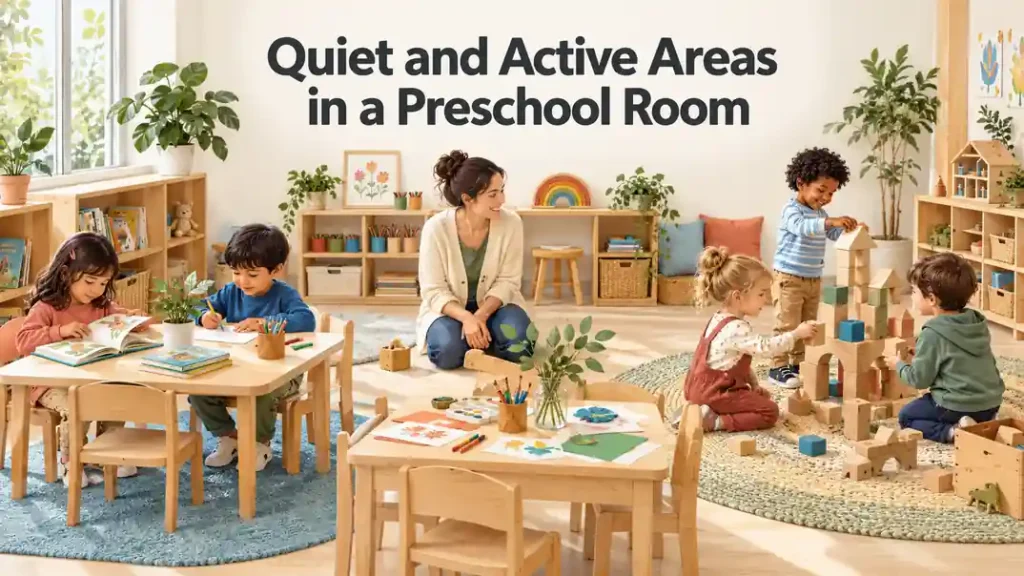
You can give children a place to read and a place to build, yet still find that neither area works well. Blocks spread toward the books. Children carrying materials pass through a small group. A story stops each time a nearby activity gets busy. The useful question is how the two activities work at the same time.
To plan quiet and active areas in a preschool room, look at movement, sound, attention, the number of children involved, and the way each activity changes during the day. You can then decide which activities can sit together, which need a buffer, and which work better at different times.
Judge Activities by What Happens, Not by Their Names
A book corner is usually quiet, but a group telling stories there may not be. Block play may involve careful building by two children or a larger group carrying pieces across the floor. Judge each activity as you actually use it.
| Ask about the activity | Quiet work may need | Active work may need |
|---|---|---|
| حركة | An entry that does not cut through another task | Space to stand, turn, carry, and build |
| Sound | A voice you can hear without competing with a nearby activity | Room for conversation and occasional louder moments |
| انتباه | Time to stay with a book, puzzle, or conversation | Freedom to work with others and change direction |
| Group size | A place for one child, a pair, or a small group | Space that still works when more children join |
This gives you a better starting point than a list of centers. If you are still deciding which centers to include, the guide to setting up learning centers covers those choices. Here, the focus is on how the activities affect one another.
Choose Activities That Can Happen Side by Side
You do not have to put every active activity at the far end of the room. You do need to consider what will happen when both areas are in use. Some pairs work well with a shared edge; others need more separation or different times.
| Activities running together | What to watch | A useful adjustment |
|---|---|---|
| Books or puzzles beside small-group art | Children stopping to watch or join the table | Keep the art group small and give each activity its own entry |
| Quiet reading beside block play | Carrying, growing structures, and the sound of blocks landing | Keep block materials on the block side; protect the reading entry from crossing traffic |
| Small-group conversation beside music or energetic dramatic play | A voice that becomes hard to hear | Run the loudest part at another time or move that activity farther away |
| Careful movement beside seated work | Bodies turning or travelling close to chairs | Leave a clear movement area that does not pass behind seated children |
Use this table to test your room, not as a fixed rule for every class. Your group size, materials, and daily routine can change the answer.
Give Each Area What It Needs
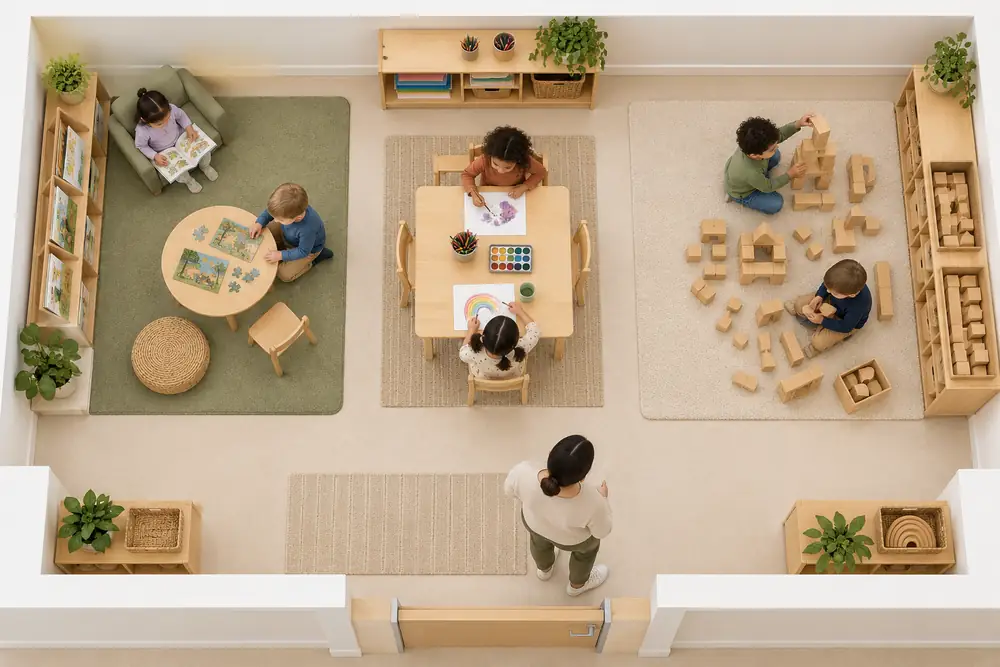
Start with the activity that is easiest to interrupt. A book, puzzle, drawing, or small conversation needs a place where children can settle without people repeatedly passing through. Keep its entry clear and make sure you can still see into it. The classroom reading corner guide covers book displays, seating, and sizes if you need to plan that one area in detail.
Then look at how the active activity grows. A block build takes more space when children stand beside it, carry pieces, or invite a friend to help. Dramatic play may need a way in and out as roles change. Leave usable floor around the activity, not only around the furniture.
The space between the two areas can support art, sorting, or a short small-group task. Give that middle area a clear purpose. If it becomes a place where everyone walks through or leaves spare materials, it will interrupt both sides.
Check How Sound Travels Between Areas
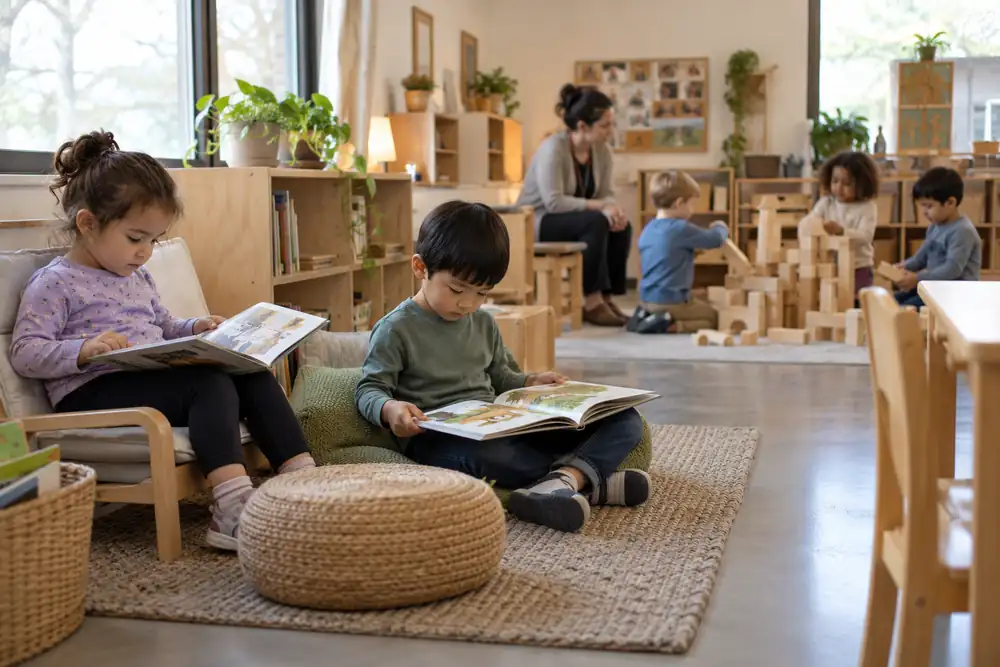
Sound is one part of this decision. A steady conversation may be easy to work beside, while a sudden block crash or a burst of music can stop a story. Listen from the quiet area while the active activity is actually happening. Can you speak in a normal voice? Can a child continue a task without looking up each time?
If the answer is no, check what makes the sound before you change the whole room. A smaller group, a different material, a clear way to put blocks down, or a different time for music may be enough. A rug or soft surface can reduce some impact noise, but it cannot make every nearby activity quiet.
Your aim is a room where children can hear you and each other while active play still feels welcome. You do not need silence.

Keep Movement and Supervision Connected
Watch what happens when children get materials, return them, or leave an activity. If block storage is on the far side of the reading space, the quiet area becomes a crossing point. If the active area occupies the only clear path to the sink, the build will be interrupted all morning. Keep the materials used most often near the activity and preserve a path around both areas.
Check the room from the places where you actually work, including the main table and the entrance. You should be able to notice a child who needs help in the quiet area while staying aware of active play. Low, open furniture can show where one area ends, provided it does not block your view or create a narrow passage. The wider guide to preschool classroom layout mistakes covers blocked views and routes in more detail.
Furniture can help set these edges, but the activity comes first. Once you know the space each task needs, you can compare storage, tables, rugs, and seating in the classroom furniture range.
Let the Pairing Change During the Day
The same room does not need the same balance from opening to closing. At arrival, you may need a calm activity children can join easily. During free choice, books, art, and blocks may run together. At group time, clear listening matters more. During cleanup, carrying and returning materials briefly make the room more active.
Choose which activities can overlap at each point in the day. If a quiet small group repeatedly stops when music begins, change that pairing or its timing. If active work keeps expanding beyond its area, reduce the group using it or give it more floor. These changes may work without moving any furniture.

Watch the Room Before You Finalize It
Try the areas during normal use and look for a repeated pattern. Does a child leave focused work whenever active play starts? Do children have to cross a build to reach materials? Can you hear and see both areas from the places where you support them?
Change the cause you can identify. Adjust one activity’s group size, material, position, or time, then watch the next session. This tells you whether the two areas work together before you commit to more products or a larger change.
الأسئلة الشائعة
- Is a quiet area the same as a calm corner? No. You use a quiet area for activities such as books, drawing, or puzzles that need fewer interruptions. A calm corner has a different purpose: helping a child pause and regain comfort. If one place must serve both uses at different times, keep its purpose clear so focused work is not unexpectedly displaced.
- Does an active area always need more floor than a quiet area? No fixed ratio works for every room. Compare how many children use each area at once and how much space the activity takes when it is underway. A large story group can need more floor than two children building, while a larger block group can reverse that balance.
- Should you keep the quiet area open during rest time? Check how your rest routine uses the room. Books may remain available to children who are not sleeping, but a reading space is not automatically a suitable sleep space. Plan rest arrangements and supervision around the requirements that apply to your setting.
خاتمة
When you plan quiet and active areas in a preschool room, look at the activities together. Give focused work room to continue, give active play room to change, and check movement, sound, and adult attention while both areas are in use. Xiair World can help you connect those decisions with the right classroom products and planning support.