
 Arabic
  English
  French
  Italian
  German
  Spanish (Spain)
  Thai
Thai  Japanese
  Turkish
  Indonesian
  Vietnamese
  Polish
  Portuguese
  Malay
Malay  Swedish
  Spanish (Mexico)
STEM and STEAM are closely related, but each puts a different weight on the learning process. STEM brings together science, technology, engineering, and mathematics. STEAM keeps those four areas and adds the arts.
In early childhood, the difference is easy to see when you look at what children do with a question. STEM may lead children to test why a bridge falls. STEAM may ask them to test the bridge, redesign it, draw the plan, and explain the idea through a story or model. Both approaches work through play, questions, materials, and conversation.
If you are still deciding how to use these ideas in your setting, start with the learning goal. Your goal should decide the activity, the materials, and the amount of structure in the room.
For a simple introduction to STEM in the early years, you can also read STEM education in early childhood.
What STEM And STEAM Mean
Both approaches help you turn a child’s question into something that can be explored. The main difference is what you add to the investigation and how children show their thinking.
STEM Keeps The Question Focused
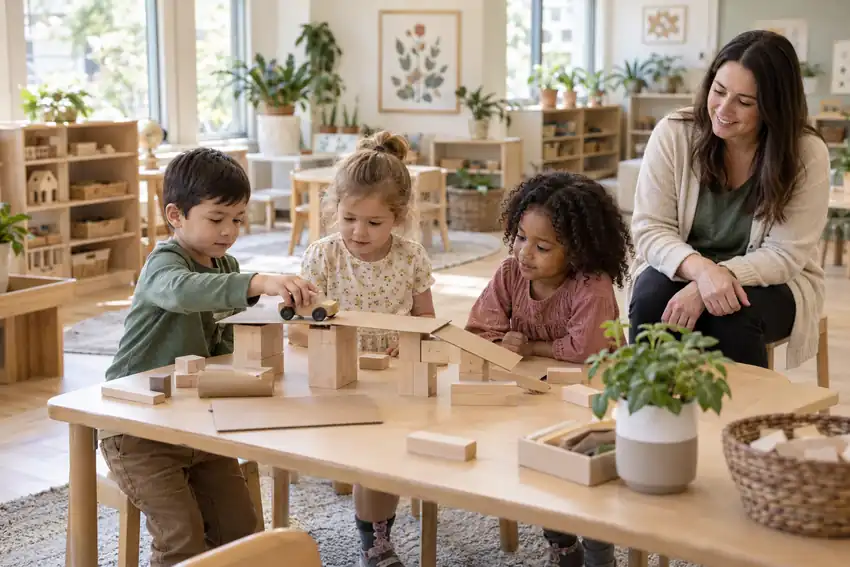
STEM learning often starts with a problem that can be observed, tested, measured, sorted, or built. You might explore which material holds the most water, how many blocks make a stable tower, or what happens when you change the slope of a ramp.
The activity does not need advanced technology. Blocks, tubes, water, sand, natural objects, measuring tools, and simple wheels can all support early STEM learning. The useful part is the process: notice something, make a guess, try it, and talk about what happened.
STEAM Adds Another Way To Show Thinking
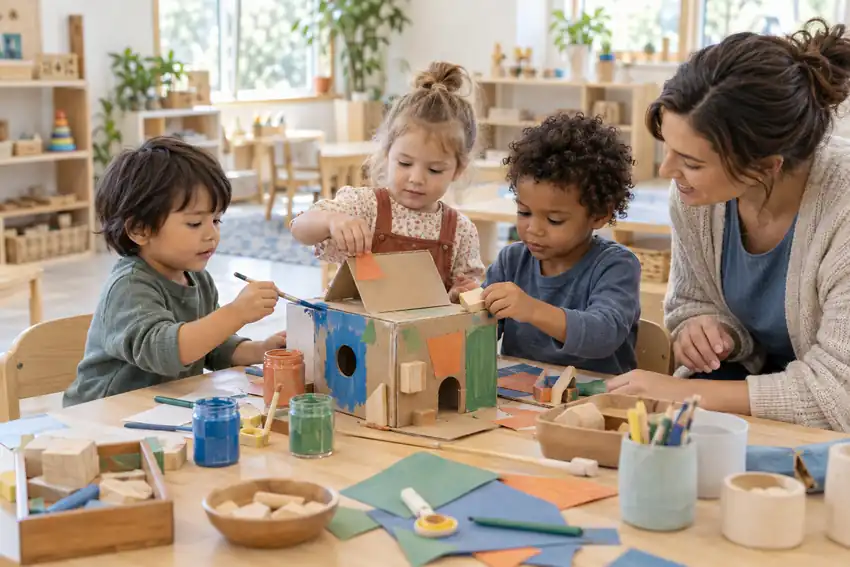
STEAM adds art to the same kind of investigation. In early childhood, art can include drawing, design, music, movement, drama, storytelling, or making a model. The arts are not just a separate craft placed beside a science activity. They give children another way to explain an idea, change a design, or share a result.
For example, after testing a bridge, you might invite children to draw a stronger version, build a model for a toy animal, or create a story about who will use it. The engineering question remains, but children have more than one way to respond.
Where The Difference Shows Up
The two approaches can use the same materials. The difference usually appears in the question you set, the choices children can make, and the way you look at the final work.
| Part Of The Experience | ينبع | بخار |
|---|---|---|
| Main focus | How something works or how a problem can be solved | How something works and how an idea can be designed or expressed |
| Typical child action | Build, test, compare, count, measure, or sort | Build, test, redesign, draw, perform, model, or tell a story |
| Possible result | A working solution or a clearer explanation | A working solution plus a design, story, model, or other form of expression |
| What you notice | Reasoning, cause and effect, persistence, and early maths | Those skills together with design choices, communication, and creative thinking |
This is a planning guide, not a strict divide. One activity may begin as STEM and become STEAM when children start using design, art, or storytelling to develop their idea.
How To Choose A Starting Point
You do not need to choose one approach for the whole classroom. Choose a starting point for the question in front of you, then allow the activity to develop in a natural direction.
Use STEM When The Process Needs More Structure
Start with STEM when you want children to focus on a clear cause and effect, a repeatable test, a pattern, a measurement, or a building problem. A short ramp investigation, a sorting challenge, or a tower that needs to stand for ten seconds can give children a clear task without making the activity feel like a worksheet.
Bring In STEAM When Children Have More Than One Answer
Move towards STEAM when the activity benefits from design, choice, or personal expression. If children are building a home for an insect, they can test the structure, choose materials, draw the layout, and decide how to present the finished idea. The art is part of the solution, not an extra task after the real learning is finished.
Let Both Approaches Meet
Early learning rarely stays inside one label. You can begin with a STEM question, then give children time to design, explain, and revise. You can also begin with a story or art idea, then use counting, measuring, or testing to make the idea work.
What It Looks Like In Your Classroom
The strongest examples are simple enough to repeat and open enough for children to make choices. You do not need a special laboratory. You need a clear question, suitable materials, and enough time to try more than one idea.
Building And Testing
Set out blocks, tubes, connectors, paper, tape, or loose parts and give children a problem to solve. A bridge must hold three toy animals. A ramp must make a ball travel farther. A tower must stay upright when one more block is added.
You can support the activity with simple questions: What changed? Which part moved? What could you try next? These questions keep the focus on the process instead of making you give children the answer.
Designing And Explaining
After children test an idea, give them a way to show what they noticed. Children can draw a plan, label a model, use movement to show how something works, or tell a story about the people or animals who will use it. This is where a STEM investigation can grow into a STEAM experience.
Recording The Process
Keep the first drawing beside the final model. Add a photograph, a short child comment, or a simple record of what changed. You are not looking for a perfect product. You are keeping evidence of a question, a choice, a test, and a new idea.
For more activity ideas that can begin with a question and develop through hands-on work, see STEM activities for kids.
Let The Room Support The Learning
Your room does not need to look like a technology lab to support STEM or STEAM. It needs to make it easy to reach materials, work with others, leave a project in place, and return to an idea later.
Give Children A Surface That Can Change
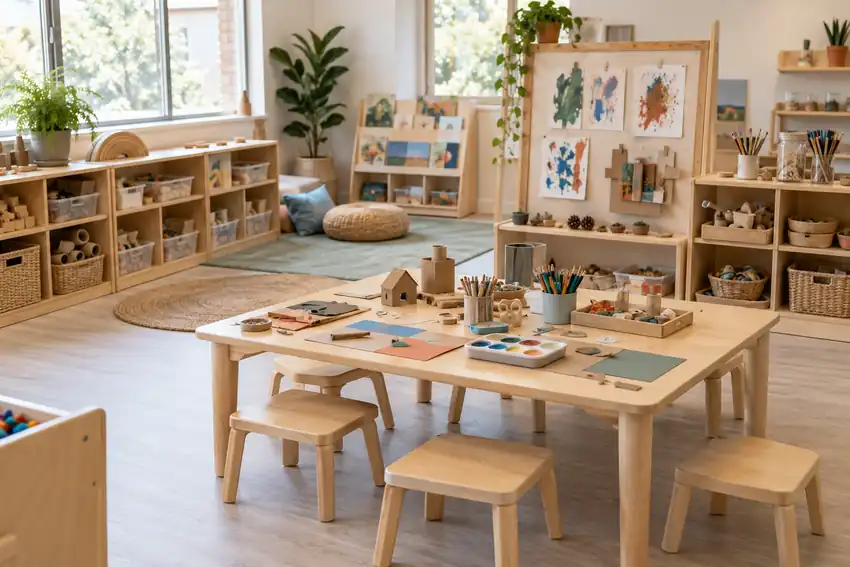
A table with enough clear space helps children spread out materials, compare parts, and work together. A surface that can be wiped easily is useful when the same area is used for water, paint, clay, or building. Open floor space gives children another option when a project becomes too large for a table.
Keep Materials Visible And Easy To Return
Open shelves, clear bins, and simple labels help children see what is available. You can place everyday building materials at child height and keep tools that need closer support in a separate area. When children can find and return materials, the activity can continue without you stopping the whole group.
You can review options for tables, shelves, and other classroom pieces through classroom furniture for active learning spaces. The right choice depends on your age group, room size, cleaning routine, and the kind of work you want to leave available.
Leave Room For Work In Progress
Some investigations need more than one session. Leave a safe place for a model, drawing, or collection of materials so children can return to it without starting again. A display surface can also help children compare different solutions and explain what changed.
Keep The Experience Right For The Age Group
The same STEM or STEAM idea should look different at different ages. Keep the materials safe and the question simple, then adjust the amount of choice and explanation that you expect.
| الفئة العمرية | Good Starting Point | How You Can Extend It |
|---|---|---|
| الأطفال الصغار | Fill, empty, stack, roll, match, and notice sound or movement | Add simple choices such as more or less, fast or slow, loud or quiet |
| مرحلة ما قبل المدرسة | Build, test, sort, measure, and compare materials | Add drawing, design, pretend play, or a short explanation of the result |
| Older Children | Plan a solution, test it, and change one part at a time | Record the process, compare different solutions, and present the final idea |
For younger children, the learning may be visible in a repeated action or a new word. For older children, you may see a plan, a comparison, or a reason for changing the design. Both are valid ways to build early STEM and STEAM thinking.
Use Reliable Guidance Without Making The Activity Formal
Early STEM and STEAM should still feel like active learning. The NAEYC guidance on STEAM describes young children learning through inquiry, conversation, hands-on experiences, and reflection. Head Start also explains that young children can build early STEAM skills by asking questions and exploring how things work, without needing special equipment.
Head Start’s STEAM guidance also puts the focus on questions, exploration, and trying to understand how things work. Use those ideas to check your own activity. Can children touch and change the materials? Can you give them time to try again? Can you talk about what they noticed instead of moving straight to the correct answer? If the answer is yes, you already have a useful base for STEM or STEAM learning.
الأسئلة الشائعة
- Do you need digital tools for early STEM learning? No. Digital tools can be useful, but blocks, water, light, natural materials, wheels, and measuring tools can support strong early STEM experiences.
- Does adding a separate art activity make a lesson STEAM? Not by itself. The arts should help children design, explain, represent, or rethink the same problem. A craft that has no connection to the investigation is simply a separate activity.
- How can you document STEM or STEAM without testing children? Keep a short record of the question, the materials, the child’s first idea, what changed, and what the child said or did next. The process gives you more useful information than a right-or-wrong score.
خاتمة
STEM gives you a clear way to explore how something works. STEAM keeps that process and adds design, art, movement, music, or storytelling as another way to think and communicate. You do not need to choose one label for every activity. Start with the question, provide materials that children can use, and let the learning develop from there.
Xiair World can help you connect that learning approach with practical classroom furniture, storage, surfaces, and room planning when you need the space to support both testing and creative work.