 French
  English
  Arabic
  Italian
  German
  Spanish (Spain)
  Thai
Thai  Japanese
  Turkish
  Indonesian
  Vietnamese
  Polish
  Portuguese
  Malay
Malay  Swedish
  Spanish (Mexico)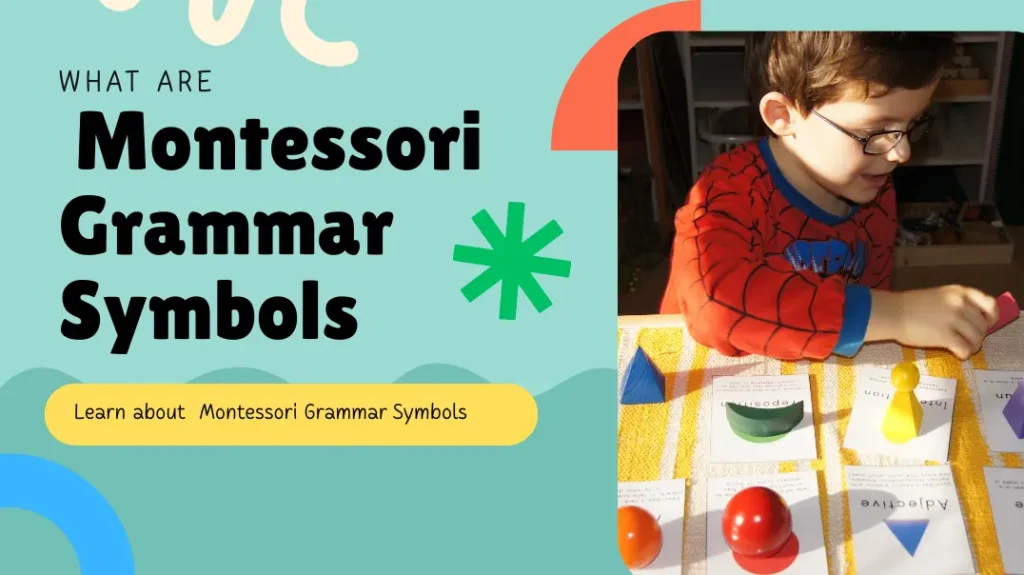
Montessori Grammar Symbols are a set of visual symbols used in Montessori education to represent parts of speech and sentence structure. Each symbol corresponds to a specific grammatical function, using consistent colors and shapes to make language structure visible. Instead of explaining grammar through abstract definitions, Montessori Grammar Symbols allow children to identify how words function within a sentence by working directly with these symbols.
These symbols are used within the Montessori language curriculum to support children who are already working with short sentences in reading and writing, and they can be adapted for home, school, or homeschool settings. Montessori grammar symbols are commonly introduced in the early elementary years but can be used with both younger fluent readers and older learners, including children in mainstream classrooms or bilingual and ESL environments in the US, Canada, Australia, and other English-speaking contexts.
Montessori Grammar Symbols are often misunderstood as a fixed set of teaching tools, yet their real value lies in how and when they are introduced. Without understanding their purpose, timing, and proper use, the symbols can feel mechanical or unnecessary. To make sense of their role in language learning, it is essential to look beyond what the symbols are and examine why they were created, how children are prepared for them, and how they are used in practice across different learning environments.
Understanding Montessori Grammar Symbols and Their Role in Language Learning
In a Montessori setting, language is never taught as an isolated subject. It is woven into daily life, conversations, stories, and real writing. Montessori grammar symbols fit into this bigger picture. They allow children to take a sentence they already know and enjoy, then “decode” it by placing symbols above or below each word. Over time, they begin to notice patterns: which words tend to name people and things, which words show action, which words add detail, and how these words work together to carry meaning.

Because Montessori grammar symbols are physical objects, they invite children to experiment. A child might build a sentence with word cards, then choose symbols to match each word. If something feels wrong, they can swap a word, move a symbol, or test a new sentence. This freedom to play with language supports a much deeper kind of understanding than simply memorizing definitions like “A noun is a person, place, or thing.” Children begin to feel how language works from the inside out.
In classrooms across the United States, Canada, and Australia, Montessori Grammar Symbols are often used in both early elementary and later language work. They support native English speakers as well as children learning English in bilingual or multilingual environments. Because the symbols rely on visual logic rather than complex explanations, they are accessible to a wide range of learners.
In short, Montessori grammar symbols are not just pretty shapes on a shelf. They are a carefully designed system that helps children see the invisible structure of language. By turning grammar into something concrete and interactive, these materials support clearer thinking, more accurate reading and writing, and a deeper appreciation of how words work together to express ideas.
Basic Montessori Grammar Symbols
Why Montessori Grammar Symbols Were Created in Montessori Education
Montessori grammar symbols were created because Maria Montessori observed that children learn best when they can move, handle real objects, and move from concrete experiences to abstract understanding. Traditional grammar teaching often jumps straight to the abstract: definitions, rules, and exercises on paper. Montessori noticed that this approach did not match how young children’s minds naturally work.
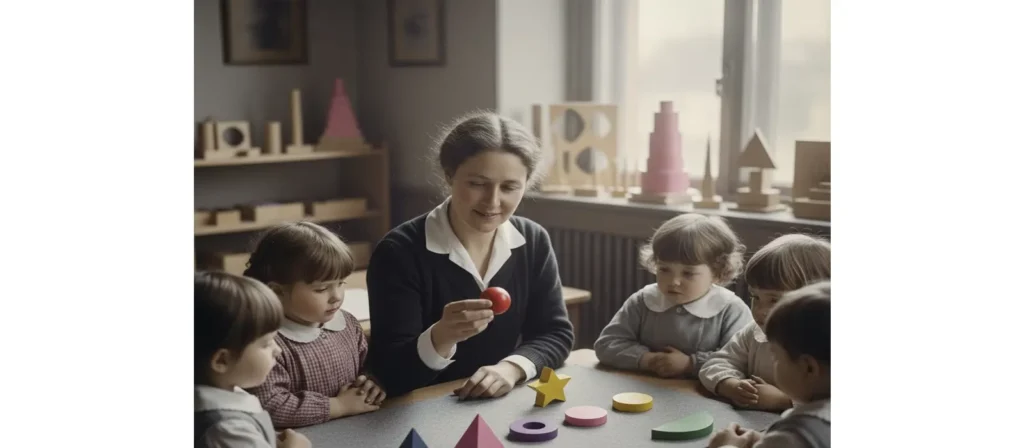
Montessori also believed that grammar should come after language, not before it. Children naturally acquire spoken language without formal instruction. They build vocabulary, sentence structure, and expression through use. Grammar symbols were created to honor this natural process. Instead of teaching grammar as a prerequisite for reading and writing, Montessori Grammar Symbols help children reflect on the language they already know. Grammar becomes a tool for refinement rather than a barrier to expression.
This insight led to the creation of Montessori Grammar Symbols. Each part of speech was assigned a specific shape and color based on its function in language. These choices were intentional, not decorative.
This is why Montessori grammar symbols have remained a core part of Montessori language education for decades. They grew directly out of observation of real children and were shaped to meet their needs: the need to move, to see patterns, to work independently, and to understand the world of language in a way that feels both concrete and meaningful.
Advantages of Using Montessori Grammar Symbols
Once you understand what Montessori grammar symbols are, the next natural question is: why use them at all? From a parent’s point of view, they can look like just another set of little shapes on the shelf. But when you look more closely at how children interact with Montessori grammar symbols, their advantages become very clear. They make grammar tangible, support independent reading and writing, and help children think more deeply about how language works.
Montessori grammar symbols are not meant to turn children into mini linguists. Their real purpose is to give children tools so that language feels manageable instead of overwhelming. When grammar becomes less mysterious, children usually feel more confident about reading, writing, and even speaking.
Making Abstract Grammar Concrete for Children
Grammar is inherently abstract. Adults can effortlessly talk about “verbs,” “adjectives,” and “prepositions,” but for children, these are abstract concepts. They can’t see verbs or hold adjectives in their hands. And that’s where the beauty of Montessori grammar symbols lies.
This concrete representation helps children who might struggle with understanding abstract definitions. Instead of rote memorization of “a verb is a word that expresses action,” they see that a red circle is always paired with words that express action or a state of being. Over time, they connect the visual pattern with the underlying concept. These symbols act as a bridge, connecting the word itself to the deeper concept of its function within a sentence.
Because these symbols are used repeatedly in many different sentences, the abstract concept of each part of speech gradually becomes ingrained. Children move from “I know which symbol to use here” to “I understand what this word does.” This transformation is precisely the goal of grammar instruction.
Supporting Independent Reading and Writing Skills
Montessori grammar symbols help children understand how words connect in sentences, supporting independent reading by linking meaning with structure. While research specifically on the grammar symbols themselves is limited, broader studies of the Montessori language curriculum suggest that Montessori students generally perform better in reading and literacy than students in traditional programs. For example, empirical research on Montessori language instruction in public schools has found a positive impact on reading achievement and language arts skills, and a study by the Arizona Department of Education indicated that the Montessori method indirectly enhances foundational literacy skills, including grammatical awareness, through structured materials and exploration.
In writing, the ability to practically analyze sentence structure helps cultivate a sense of control and confidence in children. Instead of guessing or relying on adults for corrections, children use symbols to identify parts of speech, allowing them to independently improve their writing. This aligns with research from the Montessori Family Center, which shows that the Montessori method, emphasizing multi-sensory, self-directed learning materials, promotes language development, critical thinking, and long-term academic skills. Ultimately, children produce written work with clearer sentence structures and a deeper understanding of language mechanics.
Encouraging Analytical Thinking about Language Structure
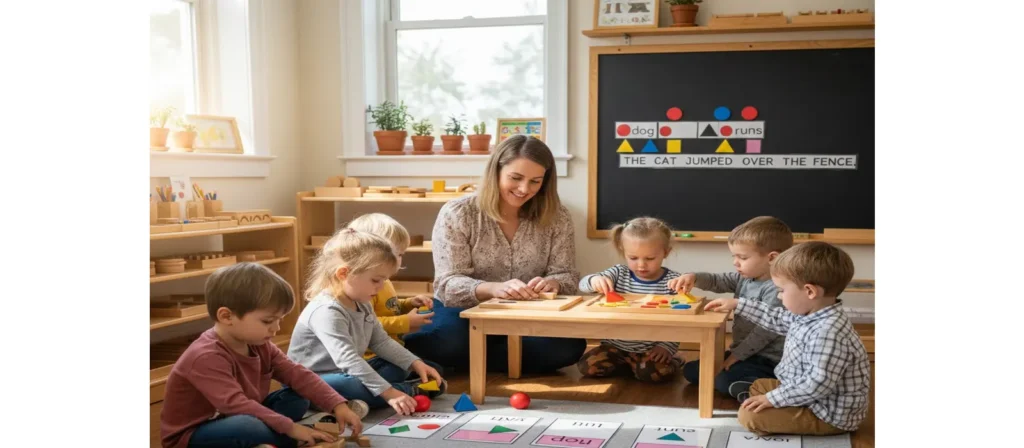
Montessori grammar symbols naturally guide children to explore how sentences are constructed, rather than simply memorizing rules. By manipulating these symbols, children practice breaking down sentences, identifying subjects, predicates, and modifiers in a way that resembles problem-solving rather than rote memorization. This hands-on, analytical learning aligns with broader findings in Montessori research, which show that Montessori education can improve cognitive functions such as problem-solving and logical reasoning abilities, skills closely related to language analysis and comprehension.
Furthermore, as children think about grammatical structures through symbols, they begin to notice patterns that extend to reading and writing. This analytical engagement is consistent with the cognitive benefits associated with Montessori education, where students often develop stronger executive functions and sustained attention, skills crucial for complex language use. While specific quantitative data on the grammar symbols themselves are not yet widely published, the Montessori emphasis on sensory-based materials and independent analysis is supported by research indicating that Montessori learning environments can enhance critical thinking skills.
Benefits for Different Types of Learners (Visual, Kinesthetic, etc.)
Montessori Grammar Symbols are especially effective because they address multiple learning styles at once. Research in early literacy consistently shows that children do not process language in the same way. Studies referenced by the American Psychological Association indicate that students exposed to multisensory instruction can improve language retention by up to 30 percent compared with single-mode instruction. Montessori Grammar Symbols combine visual cues, physical manipulation, and verbal language, which makes grammar accessible to visual learners who rely on color and shape, as well as to children who need concrete reference points to understand abstract ideas.
For kinesthetic learners, the physical act of placing and moving symbols plays a critical role. Educational studies on hands-on learning environments suggest that movement-based interaction can increase engagement and on-task behavior by 20 to 25 percent in elementary learners. Montessori Grammar Symbols allow children to interact physically with sentence structure, turning grammar into an active process rather than passive listening. This is particularly beneficial for children who struggle in traditional language lessons but thrive when learning involves motion and choice.
Language-sensitive learners, including English language learners, also benefit from Montessori Grammar Symbols because meaning is reinforced visually rather than explained repeatedly through complex verbal instruction. Research on visual scaffolding in language learning shows that symbolic supports can significantly reduce cognitive load and improve comprehension accuracy. By separating word function from vocabulary difficulty, Montessori Grammar Symbols help children focus on structure first, supporting clearer understanding regardless of language background.
Across classrooms in the United States, Canada, and Australia, this adaptability is one reason Montessori Grammar Symbols remain widely used. They do not favor one type of learner over another. Instead, they create a shared visual language for grammar, allowing children with different strengths to access the same content with confidence and clarity.
Taken together, these advantages explain why Montessori grammar symbols have stayed central in Montessori language programs around the world. They make grammar concrete, support independent reading and writing, foster analytical thinking, and meet the needs of many different types of learners. For families and teachers in the US, Canada, and Australia who want a more child-friendly approach to grammar, Montessori grammar symbols offer a practical, time-tested option.
When to Start Using Montessori Grammar Symbols
Parents and teachers often have the same question in mind: “When is the right time to bring in Montessori grammar symbols?” It is a fair question, because starting too early can feel confusing for the child, and starting too late can mean missing a beautiful window of interest. The good news is that you do not need to guess. There are clear signs of readiness you can watch for, a typical age range that works for many children, and simple ways to adapt the use of Montessori grammar symbols at home and in the classroom.

Signes de préparation
Montessori Grammar Symbols are most effective when introduced at the right developmental moment. Readiness is not determined by age alone, but by observable language behaviors.Here are some key signs that a child may be ready to work with Montessori grammar symbols:
- Strong interest in spoken language
The child enjoys conversations, storytelling, wordplay, or expressing ideas verbally, and shows curiosity about how words are used. - Beginning or emerging reading skills
The child can read simple words or sentences, or is actively working through early reading stages with growing confidence. - Awareness of sentence structure, even if informal
The child notices when a sentence sounds “wrong,” rearranges words when speaking, or experiments with phrasing to make meaning clearer. - Ability to focus on a short, structured activity
The child can concentrate on a guided task for a reasonable period and follow a clear sequence of steps without frustration. - Enjoyment of classification and pattern work
The child shows interest in sorting, matching, labeling, or finding patterns, which are foundational skills for understanding grammatical relationships.
When several of these signs are present, Montessori Grammar Symbols can be introduced as a supportive tool rather than a formal academic demand, allowing grammar to emerge naturally from the child’s existing language strengths.
Typical Age Range
Although Montessori education is always guided by readiness rather than strict age rules, it can still help to have a general sense of timing. In many Montessori environments, children are introduced to the simplest Montessori grammar symbols somewhere around age six to seven. This usually follows a period of strong growth in reading and writing during the earlier years.
- Younger children (around 5½–6)
If a child is an early and confident reader, they may show interest in grammar symbols a little earlier. For these children, you might start with just the most basic contrast, such as noun and verb, keeping sentences very short and concrete. - Typical lower elementary (6–9)
For most children, the bulk of Montessori grammar symbol work happens in the early elementary years. This is when they are curious, capable of more abstract thinking, and ready to handle more complex sentences. You can gradually introduce adjectives, adverbs, prepositions, conjunctions, and other parts of speech as they are ready. - Older children (9 and up)
Montessori grammar symbols are not “too babyish” for older children. In fact, they can be an excellent way to support children who missed earlier grammar work, are learning English as an additional language, or struggle with traditional grammar instruction. The key is to choose sentences and texts that respect their age and interests.
If your child or students are outside the typical age range but show strong signs of readiness and interest, you can still use Montessori grammar symbols. Just adjust the pace and the content to match their level.
Using Montessori Grammar Symbols at Home vs. in the Classroom
Montessori Grammar Symbols can be used effectively in both home and classroom settings, but the approach often differs. In classrooms, symbols are typically introduced through structured presentations and revisited through progressive language work, sentence analysis, and group activities. The classroom environment allows children to observe peers, work independently, and revisit materials regularly, reinforcing understanding through repetition and choice.
At home, grammar symbols are often used more selectively. Parents may introduce them to support reading comprehension or writing confidence rather than follow a full grammar sequence. When used at home, shorter sessions and practical sentence work tend to be more effective than formal lessons. In both settings, the key factor is consistency and restraint. Montessori Grammar Symbols work best when they support natural language development, not when they are used to push formal grammar instruction too early.
Introducing Montessori Grammar Symbols to Children
When Children Are Ready
Introducing Montessori Grammar Symbols should always be guided by readiness rather than curriculum timelines. When children show comfort with spoken language, emerging reading skills, and curiosity about how sentences work, grammar symbols can deepen understanding instead of creating pressure. At this stage, children are no longer focused only on what words say, but on how meaning is formed. This natural shift makes grammar symbols feel relevant and engaging rather than abstract.
It is important that grammar symbols are not introduced as a correction tool. They work best when children already feel confident using language and see grammar as something interesting to examine. When introduced at the right moment, Montessori Grammar Symbols support reflection and refinement, helping children think more clearly about language they already know.
How to Give the First Presentation
The first presentation of Montessori Grammar Symbols should be calm, minimal, and intentional. The adult typically introduces one part of speech at a time, beginning with the noun, using a simple sentence the child can easily understand. The symbol is placed beneath the word without lengthy explanation. The focus is on observation rather than definition, allowing the child to notice the relationship between the word and the symbol.
Repetition and simplicity are essential. The presentation should be brief and free of unnecessary language. Instead of naming grammatical rules, the adult models how symbols are used to analyze a sentence. Children are then invited to try the process themselves. This hands on approach encourages curiosity and reduces the feeling that grammar is something to memorize.
Role of the Adult
In Montessori grammar work, the adult acts as a guide rather than an instructor. The adult prepares the materials, gives clear and restrained presentations, and then steps back. Observation plays a central role. By watching how a child interacts with grammar symbols, the adult can determine when to introduce new symbols or when to allow more independent practice.
Correction is handled indirectly. Instead of pointing out mistakes, the adult encourages the child to re examine the sentence using the symbols. This supports self correction and independence. The adult’s role is not to explain every detail, but to protect the child’s relationship with language by keeping grammar work purposeful, respectful, and aligned with the child’s developmental readiness.
Montessori Grammar Symbol Activities
Sentence Construction
Sentence construction activities usually begin with a short, familiar sentence chosen by the adult or the child. The sentence is written or laid out using word cards, and the child reads it aloud to confirm understanding. After reading, the child places the appropriate Montessori Grammar Symbol beneath each word, starting from left to right, without naming grammatical terms aloud.
Once the basic sentence is complete, the activity expands by modifying the sentence. The child may replace a noun, add an adjective, or insert an adverb, then adjust the symbols accordingly. This process can be repeated with different sentences, allowing the child to see how changes in wording affect sentence structure while maintaining a clear, visual organization.
Matériels
- Word cards (cat, runs, the, etc.)
- Grammar symbols (article, noun, verb)
- Mat or clear table space
Steps
- Group cards by type: articles, nouns, verbs.
- Choose one article, one noun, and one verb.
- Arrange into a simple sentence (e.g., “The cat runs”).
- Read the sentence in a natural voice.
- Place symbols: Article (The), Noun (cat), Verb (runs).
- Build a new sentence and let the child place symbols.
Matériels
- Word cards from Activity 1
- Adjective cards (small, happy, tired, etc.)
- Grammar symbols (including adjective)
Steps
- Start with a simple sentence: “The dog sleeps.”
- Introduce an adjective card like “tired.”
- Ask where it belongs: “The tired dog sleeps.”
- Read the expanded sentence together.
- Place symbols: article, adjective, noun, verb.
- Try other adjectives and record favorites in a notebook.
Grammar Games
Grammar games are typically structured as guided challenges rather than competitive play. One common format involves presenting a sentence with missing or incorrect symbols and asking the child to correct it. Another approach is to provide a set of words and a mixed group of symbols, inviting the child to match each word with the correct symbol based on its function.
As the child gains experience, the adult may introduce timed or self-checking variations. For example, the child completes a sentence analysis independently, then compares the result with a prepared control chart. The focus remains on accurate placement and reasoning rather than speed or scoring.
Matériels
- Noun cards (rabbit, car, etc.); Verb cards
- Adverb cards (quickly, quietly, etc.)
- Grammar symbols (noun, verb, adverb)
Steps
- Place cards in three separate stacks by type.
- Pick one card from each stack.
- Form a sentence, adjusting order so it sounds natural.
- Read the sentence together.
- Place correct grammar symbols above each word.
- Repeat and set aside non-sensible combinations.
Matériels
- Prepared “incorrect” sentence cards
- Extra article, noun, verb, and adverb cards
- Full set of grammar symbols
Steps
- Place an incorrect sentence on the mat and read it.
- Ask the child: “How could we fix this?”
- Let them move or add cards to correct the sentence.
- Place grammar symbols above the fixed sentence.
- Repeat with other “broken” sentences.
Word Classification
Word classification activities begin by selecting a group of words taken from familiar reading material. These words are laid out individually, and the child sorts them into categories using Montessori Grammar Symbols as headers. Each group represents a different part of speech, and the child places words beneath the appropriate symbol.
This activity can be expanded by introducing new categories gradually or by asking the child to justify why a word belongs in a certain group. Words may also be reclassified when used in different sentences, helping the child understand that grammatical function depends on context rather than word form alone.
Matériels
- Word cards (nouns, verbs, adjectives)
- Large noun, verb, and adjective symbols
- A mat or table
Steps
- Place three large symbols in a row at the top.
- Stack shuffled word cards.
- Child reads a card and defines its meaning.
- Ask: “Is this naming, action, or describing?”
- Place the card beneath the chosen symbol.
- Read down each column together when finished.
Matériels
- Nouns, verbs, adjectives, adverbs, prepositions
- Grammar symbols for each category
- A large mat
Steps
- Lay all grammar symbols in a line along the top.
- Place mixed word cards in a single pile.
- Child reads cards one by one and sorts them.
- Place cards under the corresponding symbols.
- Read through columns one at a time.
- Repeat on other days with different category mixes.
Symbol Recognition
Symbol recognition activities focus on reinforcing familiarity with each Montessori Grammar Symbol before deeper analysis. The adult may place symbols on the table and read aloud a sentence, asking the child to select the symbol that matches a specific word. In other variations, symbols are placed first, and the child supplies a word that fits each symbol.
As recognition becomes more automatic, symbols are integrated into daily reading or writing work. The child identifies symbols within previously analyzed sentences or reviews them briefly at the beginning of a language lesson. These short, focused exercises help maintain accuracy and fluency without turning symbol recognition into memorization.
Matériels
- Physical or printed grammar symbols
- Small word labels (noun, verb, etc.)
Steps
- Place 3 or 4 symbols in a row on the mat.
- Keep word labels in a small pile.
- Child reads a label and matches it to a symbol.
- Once all labels are placed, check and adjust.
- Swap symbols and labels to repeat the game.
Matériels
- Same symbols as Activity 1
- Same word labels as Activity 1
Steps
- Lay out labels in a row (noun, verb, etc.).
- Place symbols in a mixed pile.
- Child picks a symbol and places it on its label.
- Continue until all symbols are matched.
- Remove labels to test if the child can match from memory.
Resources and Materials for Learning Montessori Grammar Symbols
Livres Montessori
Montessori books related to grammar symbols usually present language concepts in a sequential, concrete way. These books often include clear sentence examples, visual references to symbols, and simple explanations that align with Montessori language progression. They are typically used alongside matériel pratique rather than as standalone teaching tools. When selecting Montessori books, it is important to choose editions that reflect authentic Montessori language work and focus on sentence analysis instead of traditional grammar drills.
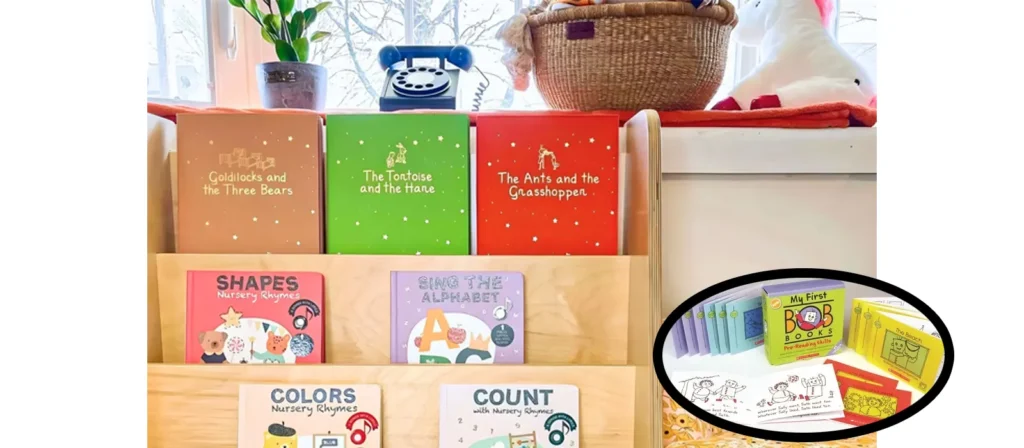
Some books are designed specifically for adult reference, offering guidance on presentation order and lesson structure. Others are written for children and can be placed on the language shelf for independent reading or review. In both cases, books work best when they support, rather than replace, direct interaction with grammar symbols.
Traditional Montessori Grammar Symbol Sets
Traditional Montessori classrooms commonly use Montessori Grammar Symbols Sets made from wood or durable plastic. These sets include the full range of symbols for parts of speech, each produced in standardized colors and shapes. Wooden sets are often preferred for their tactile quality and weight, which helps keep symbols stable during sentence work. Plastic sets, on the other hand, are lightweight and easy to clean, making them suitable for high-use classroom environments.
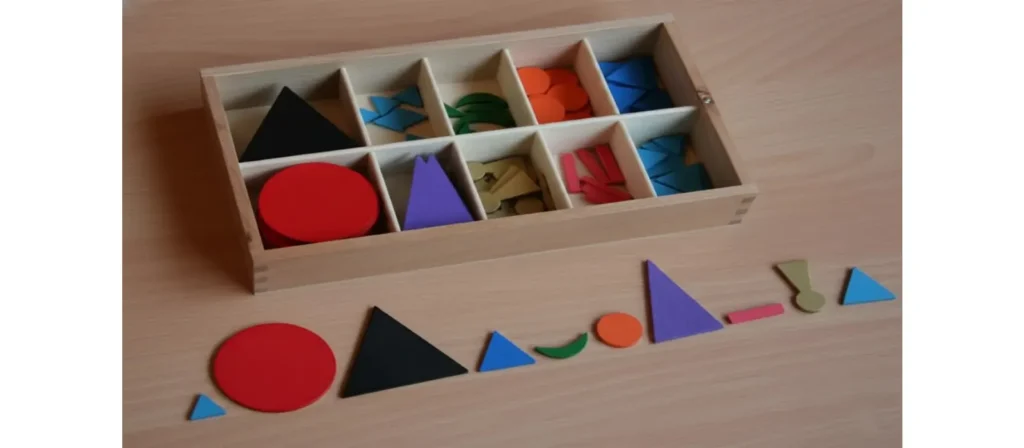
A complete Montessori Grammar Symbols Set is typically stored in a compartmentalized box or tray, allowing children to access symbols independently. Consistent size, color accuracy, and durability are key considerations when choosing a set, especially if it will be used regularly for sentence construction and classification activities.
Printable and DIY Options
Printable and DIY resources provide flexibility for families and educators who may not have access to traditional materials. Printable Montessori Grammar Symbols are often used in home settings, small classrooms, or as supplemental materials. These may include symbol cards, sentence strips, or control charts that can be printed and laminated for repeated use.
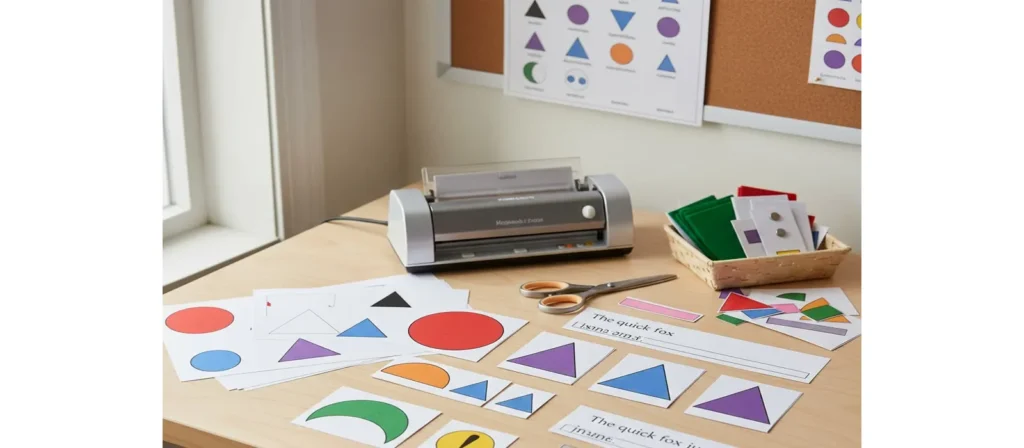
DIY options allow adults to create symbols using cardstock, felt, or magnetic materials. While these alternatives may differ in texture or finish, accuracy in color and shape remains essential. DIY materials are most effective when they closely follow traditional Montessori design standards, ensuring consistency between home and classroom experiences.
Digital Tools and Apps
Digital resources related to Montessori Grammar Symbols are increasingly available, especially for older children. Montessori Grammar Apps and interactive platforms may include sentence analysis exercises, symbol matching activities, or digital sentence construction tools. These resources are generally used as reinforcement rather than primary instruction, supporting review or independent practice.
When selecting digital tools, it is important to ensure that they reflect Montessori principles, such as self correction, simplicity, and clarity of purpose. Digital materials work best when they complement hands-on grammar symbol work, not when they replace physical interaction with language materials.
Misconceptions Related to Montessori Grammar Symbols
A common misconception is that Montessori grammar symbols only make sense for a narrow group of children, usually those who are already strong readers or unusually academic. In reality, Montessori grammar symbols can be adapted to many levels. Sentences can be as simple as “The cat runs” or drawn from complex texts, and symbols can be introduced slowly, one or two at a time, so children with different abilities can still engage meaningfully.
Another frequent misunderstanding is that Montessori grammar symbols “belong” only in fully equipped Montessori schools. While they are part of the classic Montessori language curriculum, parents, tutors, and teachers in mainstream classrooms can use the same symbols with ordinary word cards, notebooks, or printed texts. As long as the shapes and colors are consistent, Montessori grammar symbols work just as well on a kitchen table or small group corner as they do in a traditional Montessori environment.
Some adults worry that using Montessori grammar symbols will push children into dry, rule-heavy grammar too early, creating an overemphasis on grammar at the expense of creativity. In practice, the symbols are meant to sit on top of real language: stories children love, sentences they write themselves, and observations from daily life. When used this way, Montessori grammar symbols do not replace free writing or rich reading; they simply give children a clear, visual way to examine how their own sentences are built.
Conclusion
Montessori grammar symbols turn the invisible structure of sentences into something children can actually see and handle. By matching each part of speech with a clear shape and color, they give young learners a concrete way to understand how words work together, instead of meeting grammar as a vague list of rules. When children lay out word cards and place Montessori grammar symbols above each one, they are quite literally building a picture of language in front of them.
If you’d like to start using Montessori grammar symbols, you don’t need a full classroom to make it work. Begin with simple sentences, just a noun and a verb, and one small set of symbols or printables. As the child becomes comfortable, you can slowly add adjectives, articles, adverbs, and the rest, using the activities, resources, and materials you’ve seen in this guide. Over time, the symbols become a familiar toolkit you can pull into reading, writing, and even subject work like science or geography, helping children look at language with more confidence and clarity.
Ultimately, Montessori Grammar Symbols are most effective when they are viewed as tools for observation and reflection. Their value lies not in how many symbols a child can identify, but in how confidently the child can use language to express ideas with clarity and intention.