
 Spanish (Spain)
  English
  Arabic
  French
  Italian
  German
  Thai
Thai  Japanese
  Turkish
  Indonesian
  Vietnamese
  Polish
  Portuguese
  Malay
Malay  Swedish
  Spanish (Mexico)
Gross motor skills in early childhood develop through walking, climbing, pushing, carrying, balancing and changing direction. If the room only has a large piece of equipment, you may miss many of the movements children use every day.
Look at the space before you look at the product list. Can children move without running into tables? Can you see the active area? Is there somewhere to begin, pause and try again? Those answers will tell you more than a catalogue photograph.

What Counts As Gross Motor Work
Gross motor skills use the large muscles in the legs, arms, back and body. Children use these muscles when they stand up, walk across the room, climb, jump, crawl, throw, catch, push, pull and carry.
You do not need to turn every activity into a lesson. A child carrying a basket, stepping over a low beam or pushing a trolley is already working on balance, strength and control. The useful question is whether the room gives enough safe chances to move.
Small Moves Still Count
Balance is not only tested on a tall climber. A low step, a line on the floor, a soft block or a path around the room can ask for careful foot placement. Throwing a beanbag, reaching for a shelf and pulling a box also use the whole body.
Give children more than one level of challenge. A child who is still finding balance needs a steady, low starting point. Another child may be ready to move faster, carry something, or follow a longer route.
The Room Has A Big Effect
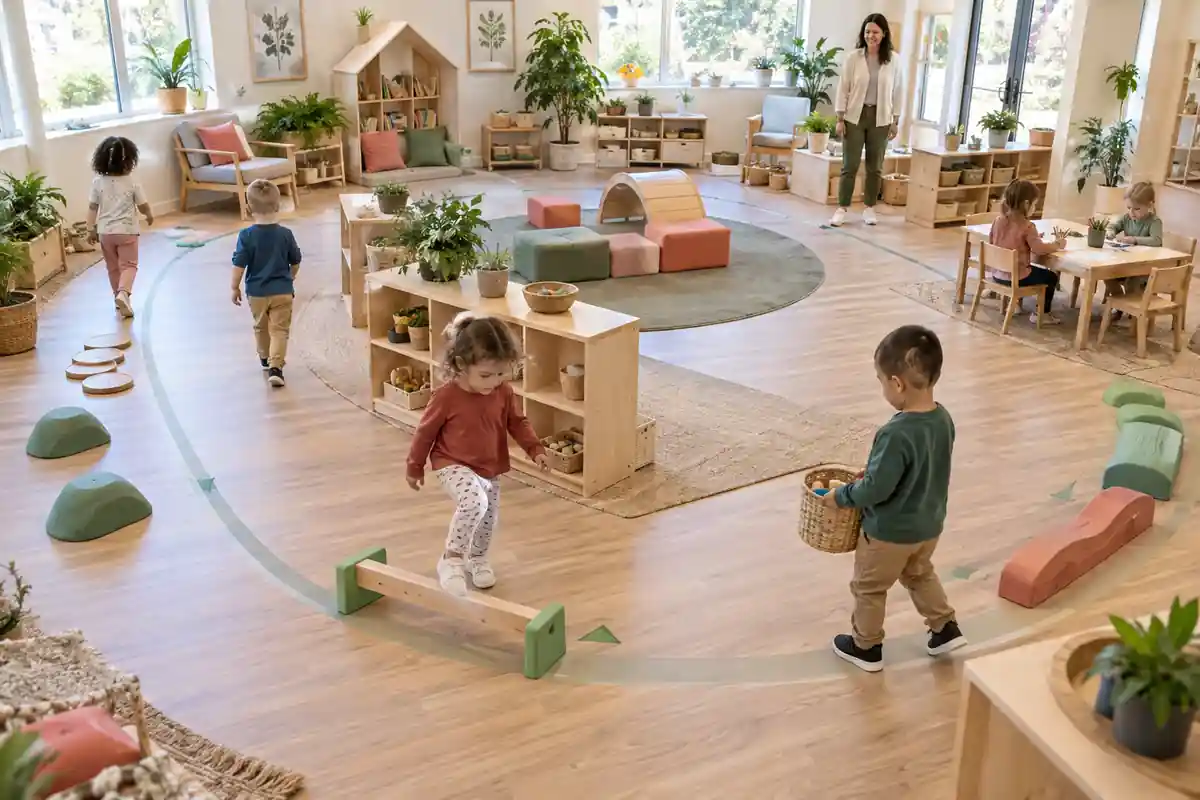
A crowded room can make children stop moving, even when good equipment is available. Tables, storage and loose parts can narrow the route or create blind corners. Before adding anything, walk through the room at the same height and pace as the children.
Notice where you can stand, where children wait and where a child might fall or turn suddenly. If you are changing more than one area, a wider review of the Disposición del aula can help you see how movement, storage and quieter work affect one another.
For the hand work that happens at tables and shelves, see fine motor skills in early childhood. The two areas meet in the same room, but they need different space and materials.
Look At The Way Children Move Through The Room
Start with the route that already exists. Children walk to the sink, the shelf, the door, the book area and the outdoor space many times a day. These routes show you where movement happens naturally and where the room is getting in the way.
Give Them A Clear Path
Leave enough space for a child to walk, turn and stop without brushing against furniture. Keep the main route easy to see. Avoid placing a large item beside a doorway or where children need to carry materials through.
A clear path does not have to be empty all day. You can place a low balance line, stepping shapes or soft blocks beside it when the activity is planned and supervised. Put the pieces away when the route needs to work as a route again.
Keep Busy And Quiet Work Apart
Children need active space, but the active space should not take over the drawing table, reading corner or small-group work. Use furniture to show where one area ends and another begins without creating a high barrier.
Look for the point where a running game would disturb another activity. A change in direction, a low shelf or a clear floor boundary may be enough. You are trying to make the room easier to read, not fill it with dividers.
Keep Your View Open
You should be able to see the main movement area from the places where adults usually work. High storage and large equipment can hide a child who needs help. Leave a direct way to reach the area without moving several objects first.
Active supervision still means watching, listening, moving closer and changing your position. The ACECQA active supervision guidance gives a useful reminder that supervision is part of the room plan, not an extra task after the furniture is in place.
Choose The Challenge After You Know The Space
A product may be suitable on its own and still be wrong for your room. Check the full use area, the children who will use it and the adult position before you decide what to buy.
Start Low When The Room Is Small
Low equipment can offer stepping, crawling, balancing and climbing without taking as much height or fall space. It can also be easier to move when the room needs to change for meals, rest or another group.
This does not mean that higher equipment is always unsuitable. It means that height is only one part of the decision. If you cannot keep the landing area clear or see the top and bottom at the same time, choose a safer arrangement.
Use One Piece In More Than One Way
A ramp can support climbing up, walking down and moving a toy. A low platform can become a step, a place to carry objects across or part of pretend play. A few large loose parts can make a new route without fixing the room to one layout.
Ask what children can do with the item after the first week. If the answer is only one action, you may be paying for a product that occupies a lot of space without giving much back.
Match The Challenge To The Group
A toddler group may need more floor movement and a low place to pull up, step over or crawl through. Older children may be ready for longer routes, throwing games or equipment that asks for more balance. A mixed-age room needs clear choices so one child’s challenge does not become another child’s obstacle.
Check body size, confidence, mobility and the amount of help needed. The age label on a product is a starting point, not a room plan.
Use The Floor Plan Before You Choose Products
Room measurements are more useful when you send them with photos and a simple floor plan. Add the age group, number of children using the space and any times when different groups share the room. If the room changes during the day, review each version of the layout.
Mark The Space Around The Item
Measure the product itself, then mark the space needed to approach it, use it, land, wait and move away. Check nearby doors, radiators, shelves, tables and sinks. The empty space around the item is part of the purchase.
For any climbing, jumping or elevated item, check protective surfacing and the full fall area against the rules that apply where you operate. The CPSC Public Playground Safety Handbook is a useful reference for age matching, protective surfacing and use zones, but it does not replace local requirements or the product instructions.
Plan For Each Group
If two age groups use the same room at different times, do not plan around an average child. One group may need a wider clear route. Another may need smaller loose parts or a lower start. A layout that works for one group may need a small change before the next group enters.
Check The Details Before A Larger Order
Ask for exact dimensions, assembly details, material, finish and fixing method. Check how the item will be cleaned and what happens when a part wears out. For a wall-mounted product, make sure the fixing method suits the wall and the way children will use it.
Use a sample, assembly drawing or inspection photos when several parts need to fit together. Look for rough edges, missing fixings, changed dimensions or a surface that does not match the approved version. A small mismatch is easier to fix before the larger order arrives.
Movement Is Already In The Day
Gross motor practice is easier to repeat when it has a real reason. You can add useful movement to routines without stopping the whole room for a special activity.
Give Children A Job To Do
Children can carry a light tray, push a safe cart, take large blocks to another area, collect outdoor buckets or help set up a pretend shop. These jobs involve walking, lifting, pushing, turning and stopping.
Keep the object light enough for the child and the route free from sudden obstacles. Let the child take enough time to move safely instead of rushing to finish the job.
Repeat The Action In A New Place
You can practise stepping indoors, across an outdoor path and over a low natural feature. You can carry baskets in the room and collect leaves or loose parts outside. The equipment does not need to match. The action is what gives the child another chance to use the skill.
Watch What Children Actually Use
If children avoid an item, check the height, starting point, surface, waiting space and route around it. If a child uses it once and leaves, the activity may be too hard, too easy or too limited. Move the item or change the materials before you decide that you need another product.
Check The Setup Before Children Use It
Keep the final check simple. Walk the route, look at the full use area and stand where you will supervise. The product, room and daily routine should make sense together.
Check The Surface And Nearby Objects
Look at the floor, landing area, clearances and furniture around the exact item. Remove objects that could catch a foot or block a quick response. Check the surface again after the room is reset, because loose baskets and chairs often change the route.
Check The Fixing And The Finish
Look at edges, handles, joints and places that children may pull or push. Confirm that the finish can handle the cleaning routine you use. If a product needs fixing to a wall or floor, keep the fixing record with the product information.
Check The Room At Child Height
Walk through the room slowly. Sit down, look behind the low furniture and check what is hidden from the usual adult position. This often shows a blocked route or a blind corner that is easy to miss when you only review a plan from above.
Sources
These sources support the points about gross motor development, room design and active supervision.
- Department for Education guidance on gross motor skills
- Head Start guidance on classroom environments
- Research on motor competence and the preschool environment
- ACECQA active supervision guidance
- CPSC Public Playground Safety Handbook
Preguntas frecuentes
- Can a small classroom support gross motor skills? Yes. Keep one useful route open, add low challenges and use carrying or tidy-up jobs. You do not need a large climber for every kind of movement.
- Should movement equipment stay out all day? That depends on the item, the group and the supervision available. If it blocks a route or creates a hidden corner, bring it out for a planned period or change the layout.
- What can you do when a large climber does not fit? Measure the full use area again. Then look at lower equipment, loose parts or another room. Do not reduce the space needed to approach, use or leave the item.
- How can you include children with different movement abilities? Offer more than one way to join in. A low step, a carrying job, a clear route or a seated throwing activity may give a child a useful starting point. Seek qualified advice when an individual support plan is needed.
Conclusión
Gross motor skills grow when children have somewhere to move, a challenge that makes sense and enough time to try again. Read the route and the room first, then choose the equipment that fits both.
If you need to check the relationship between the floor plan, dimensions and movement choices, Xiair Word can help you turn those details into a practical classroom layout.