
 Spanish (Spain)
 English
 Arabic
 French
 Italian
 German
 Thai
 Japanese
 Turkish
 Indonesian
 Vietnamese
 Polish
 Portuguese
 Malay
 Swedish
 Spanish (Mexico)
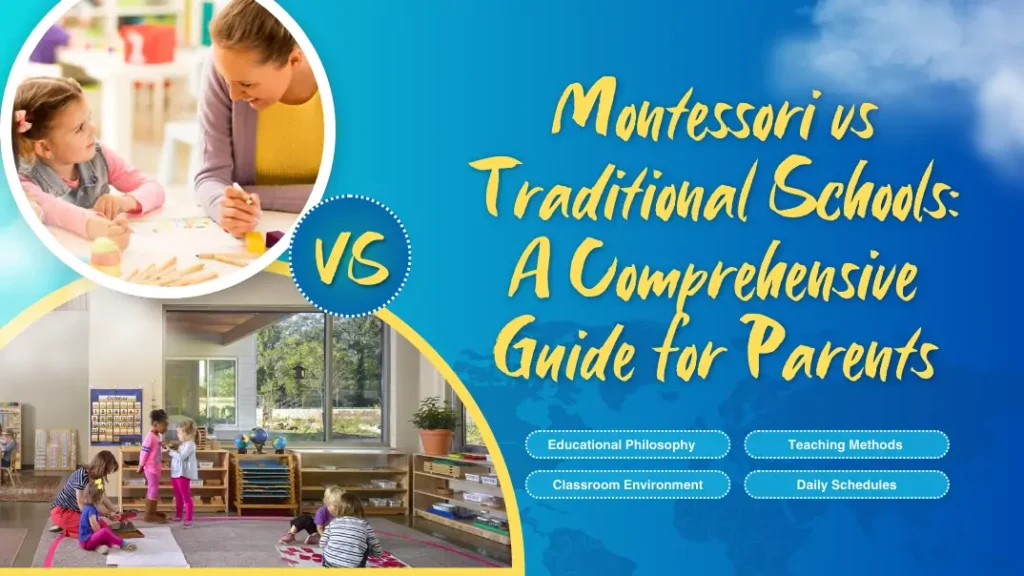
When you compare Montessori vs traditional schools, the main difference is how learning is organized: who chooses the activity, how a lesson is introduced, and what happens next. Those decisions also shape the materials and furniture a classroom needs.
This guide focuses on preschool and early childhood classrooms. “Traditional” means a non-Montessori program here, rather than one fixed teaching method. You may find a teacher-led curriculum, a play-based approach, or a mixture of both. A fair comparison starts with the way a particular classroom works.
How Teaching And Learning Differ
In Montessori, you can expect a planned curriculum with room for children to progress at different rates. A teacher introduces an activity, often individually or in a small group, before a child practices with it. Choosing work does not mean inventing a curriculum or being left to figure everything out alone.
In a more teacher-led preschool, you might see a shared topic introduced to a group, followed by activities planned around that topic. Small-group teaching and individual support can still be part of the day. For example, a story about a garden could lead to counting seeds, painting flowers, and talking about how plants grow.
The useful comparison is how the next lesson is decided. Is it mainly part of a group plan, or does it follow an individual child’s readiness? Neither answer, by itself, tells you whether teaching is good. Look for an explanation of what happens when a child needs more practice or is ready to move ahead.
Teacher preparation matters here. The American Montessori Society identifies trained Montessori teachers as a core component of the method. When planning a program, check that training covers the age group being taught.
What The Daily Schedule Allows
An uninterrupted work period is a distinctive part of Montessori. Children have time to choose an activity, stay with it, and repeat it without the whole class moving on at frequent intervals. Meals, outdoor time, and other routines still need a place in the day.
A conventional preschool may organize the morning into more clearly separated periods, such as a group meeting, learning centers, an adult-led activity, and outdoor play. Some programs also offer long stretches of free choice. Read the actual timetable before assuming that one approach is flexible and the other is rigid.
If you are considering Montessori, check whether the timetable can protect sustained work. A long morning session on paper can become a series of short activities if specialist lessons or whole-group transitions repeatedly interrupt it. In a program built around shorter sessions, check how unfinished work can be continued later. These are different scheduling decisions, with different demands on the classroom team.
How Learning Materials Are Used
Montessori materials have defined learning purposes and ways of being presented. Many allow a child to notice an error through the activity itself. The relationship between one activity and the next matters, so selecting a set is more involved than choosing attractive wooden objects. For a closer look at the main learning areas, see the guide to Materiales para el aula Montessori.
In a non-Montessori preschool, resources may be chosen around themes, learning centers, or open-ended play. A box of blocks, for example, can support building, storytelling, or a group challenge. This is a difference in how materials serve the curriculum, rather than a choice between hands-on learning and worksheets.
NAEYC’s guidance on early childhood teaching supports a combination of self-directed play, guided play, and direct instruction.
When choosing classroom resources, start with the lessons or activities you intend to offer. When reviewing Materiales Montessori, ask the trained teacher to check the proposed set and identify missing pieces. For a play-based room, consider how several children will use a resource together and whether there are enough pieces for the intended activity. The two lists need not look alike, even for the same number of children.
What Changes In The Classroom Environment
In Montessori, accessible furniture and clearly displayed activities are part of the prepared environment described by Association Montessori Internationale. You need space for a child to take an activity from its shelf, carry it to a work area, use it, and put it away.
A non-Montessori preschool might give more space to shared activity tables, construction, pretend play, or a central meeting area. There is no reason to assume that a traditional preschool needs rows of desks. Its arrangement should suit the teaching and play that actually take place.
For either approach, check the full size of an activity when it is in use. A tray that fits on a shelf may need much more room once its contents are laid out. A group construction activity may need space to stay in place between sessions. Choosing furniture from a room photograph alone can miss these everyday requirements.
Wood finish and neutral colors do not make a room Montessori. The more useful question is whether the furniture supports the intended use. For the detailed positioning of shelves, tables, and floor work areas, use the Montessori classroom layout guide.
¡No solo lo sueñes, diséñalo! ¡Hablemos sobre tus necesidades de muebles personalizados!
How Age Groups Shape Classroom Life
A Montessori Children’s House commonly brings together children around ages three to six. Within that group, a younger child can watch a familiar task being done, while an older child can show how it works. This does not mean that older children become substitute teachers, or that every activity must involve a mixed-age group.
In a preschool organized by narrower age bands, you may plan more experiences around a similar stage of development. Children of the same age still differ in language, confidence, and coordination, so a shared birth year is not a shared level of readiness. Non-Montessori programs can also use mixed-age groups; check the enrollment structure rather than relying on the school label.
For furniture, the practical consequence is to check the children who will use each room. A mixed-age group may need more than one seating size. A same-age group also needs a fit check; “preschool size” on a product description is not enough information to select every table and chair.
How Freedom And Classroom Rules Work Together
Montessori freedom comes with limits. Children can make choices while respecting other people, the materials, and the room. AMI’s explanation of classroom discipline makes clear that adults intervene when behavior becomes unsafe or disrespectful. Independence is something children gradually learn, not a condition you can expect on the first day.
In a conventional classroom, rules may be introduced and practiced more often through group routines. The approach to behavior varies between schools, however; rewards and punishments are not a reliable dividing line between every Montessori and non-Montessori setting.
To compare practice, ask how an adult responds when two children want the same activity or when a child repeatedly interrupts someone else’s work. A specific explanation tells you more than a promise of either “complete freedom” or “good discipline.” Look for a response that protects the group while helping the child understand what to do next.
How Progress Is Followed
Montessori does not mean learning without assessment. AMI describes observation as the basis for assessing progress and planning future lessons. The absence of a worksheet or a grade should not mean the absence of a record.
In other early childhood programs, you may also find observations, work samples, and developmental records. A school comparison aimed at preschool should not treat formal exams as the default alternative to Montessori. Assessment practices depend on the age group, program, and applicable requirements.
Ask to see an anonymized example of how learning is documented. You should be able to distinguish an activity that was offered from a skill a child can use independently. A list of completed activities alone gives you much less information about understanding, difficulty, or the next teaching decision.
Preguntas frecuentes
Are Montessori schools always private?
No. Montessori describes an educational approach, not a funding model. The American Montessori Society confirms that public Montessori programs exist in the United States. Availability, admissions, and funding differ by location, so compare those arrangements separately from the teaching method.
Can children move from Montessori to a traditional school?
Yes, although the adjustment will differ for each child and receiving school. Before a move, arrange communication between the two settings and clarify the new school’s entry expectations. A visit, an introduction to the new teacher, and an explanation of unfamiliar routines can help prepare for the change. Allow time to settle in, with contact between home and school if difficulties arise.
Does Montessori education continue beyond preschool?
Yes. For example, AMI describes an elementary program for ages six to twelve, with broader projects and study across subject areas. If you are considering long-term continuity, check which levels are available locally; a Montessori preschool does not necessarily have an elementary program attached.
Conclusión
A classroom visit is a useful next step in comparing Montessori and traditional schools. Ask to observe an ordinary session so you can judge the approach in practice. When you are ready to turn your educational plans into a room, Xiair World can help you review furniture and layout options against your space and age group.