
 Malay
Malay  English
  Arabic
  French
  Italian
  German
  Spanish (Spain)
  Thai
Thai  Japanese
  Turkish
  Indonesian
  Vietnamese
  Polish
  Portuguese
  Swedish
  Spanish (Mexico)
What Is a Mixed-Age Classroom?
People use the term Mixed Age Classrooms like it’s one thing. It isn’t. Sometimes it means a classroom with a narrow span—say, 3–4-year-olds together. Sometimes it’s broader. Sometimes it’s a formal model (Montessori-style multi-year cycles). Sometimes it’s a staffing or enrollment reality that schools decide to make intentional.
A mixed-age classroom definition that holds up is simple: children from more than one age group learn together in the same room as a stable community, not as a temporary overlap. That’s it. The moment it becomes “we’re short a room, so we combined groups for two weeks,” you’re in a different category, and it creates different problems.
What makes it feel like mixed-age education is the design of the environment and the day:
- routines that work for different developmental stages
- materials that don’t punish younger children for being younger
- expectations that don’t cap older children at “wait until everyone catches up”
- adults who can track multiple trajectories at once without turning the room into constant intervention
The phrase mixed-age learning also matters because it points to the mechanism. You’re not only teaching content. You’re using the social composition of the group as part of the learning system, children watching each other, copying each other, helping each other, sometimes competing a bit, sometimes settling into roles. That peer dimension is a big reason advocates like mixed-age groupings in early childhood settings.
You’ll also see multi-age classroom used interchangeably, and most of the time, that’s fine. In practice, some educators use “multi-age” when they mean a more intentional, multi-year cycle with curriculum planning built around it (common in Montessori environments). The Montessori Public Policy Initiative piece is fairly blunt that research results in conventional “mixed-age” settings can be mixed and may not map cleanly onto Montessori structures. I think that honesty is helpful.
Various forms of mixed-age classroom structures
And then there’s the part people skip: the early childhood classroom structure underneath it.
Mixed-age can be structured in very different ways:
- Looping / continuity models: children stay with the same teacher for more than one year, the group composition shifts as children age in and out. This continuity is often one of the selling points for stress reduction and relationship stability.
- Two-year bands: 3–4 together, 4–5 together, sometimes used to smooth transitions and enrollment.
- Three-year cycles: more like Montessori 3–6, where curriculum and materials assume a broader developmental range.
- Combination classes by necessity: staffing, ratios, budgets. These can work, but they need the same design discipline as intentional models, maybe more. PMC
When people argue about whether mixed-age “works,” they’re often arguing about different versions of it. That’s why research can sound inconsistent. For example, one preschool study on classroom age composition and vocabulary gains didn’t find a simple main effect of age composition on vocabulary growth, suggesting you don’t get automatic gains just by mixing ages. Quality and context still matter.
Benefits of Mixed Age Classrooms for Early Learning
Most of the widely cited benefits of mixed-age classrooms come from how children interact with one another, not from any single instructional technique. Adults don’t disappear. Structure doesn’t disappear. But the center of gravity shifts a little. Learning becomes less teacher-facing and more socially distributed. That shift matters in early childhood.
There’s a body of early childhood research suggesting that heterogeneous age groups can support social competence, peer modeling, and prosocial behavior, especially when classrooms are intentionally designed and staffed. The key phrase there is intentionally. The National Association for the Education of Young Children has long emphasized that peer interactions are a core driver of early childhood development, not a side effect.

One reason mixed-age settings keep resurfacing, across Montessori, Reggio-inspired programs, forest schools, and even some public preschool pilots, is that they align well with child-led learning. Children notice differences. They adjust to them. They test themselves against slightly older peers and steady themselves by helping younger ones. That dynamic doesn’t need to be taught. It needs to be protected from being over-managed.
At the same time, this isn’t romantic. Mixed-age environments surface gaps quickly. Social gaps. Language gaps. Regulation gaps. The upside is that those gaps are visible inside everyday activity, not isolated in assessments.
Next, we’ll slow down and discuss the specific benefits that people are typically concerned about, rather than pretending that these benefits will automatically materialize.
How Mixed-Age Classrooms Support Leadership Development
Leadership in early childhood rarely looks like the thing adults imagine. It’s not speeches or organizing groups. It’s quieter. A child shows another how to roll a mat. A child explains a rule without being asked. A child notices someone stuck and steps in.
In Mixed Age Classrooms, these moments happen more often because age differences create natural asymmetries. Older children are not “the best” at everything, but they usually have slightly more language, slightly more experience with routines, and slightly more confidence navigating the room. That’s enough.
Research on peer learning shows that teaching or explaining to others can consolidate understanding and support executive function in young children. The benefit isn’t just to the learner; it reshapes how the “leader” thinks about their own competence.
Why Mixed-Age Classrooms Help Build Healthy Self-Esteem
In same-age classrooms, comparison is constant and narrow. Everyone is working on roughly the same tasks, at roughly the same pace. Differences feel sharper. In mixed-age groups, comparison diffuses. A child can be competent in one context and still learning in another. That matters.
In well-run mixed-age education settings, younger children get repeated exposure to what “next” looks like, without pressure to arrive there immediately. Older children experience being capable without being finished. That combination tends to support a steadier, less brittle sense of competence.
There’s evidence that mixed-age grouping can reduce performance anxiety and competitive stress in early years, particularly when assessment is observational rather than standardized. Children are less likely to interpret difficulty as failure when the room itself signals that learning unfolds over time. It’s subtle. You see it in how children re-enter tasks after mistakes. In how quickly they recover.
More individualized education
People often talk about differentiation as if it’s a set of techniques. In mixed-age rooms, differentiation is baked into the environment whether you want it or not.
A multi-age classroom forces adults to stop assuming uniform readiness. Materials have to make sense at multiple levels. Instructions have to be flexible. Progress has to be tracked individually, because the group no longer moves as one.
That pressure can feel heavy at first. But it often leads to more honest pedagogy. Teachers start watching more closely. They stop waiting for “the lesson” to reveal understanding and begin noticing it in play, repetition, avoidance, and variation.
Studies on mixed-age and Montessori-style environments suggest that individualized pacing—when supported by appropriate materials, can increase engagement time and reduce off-task behavior. Children spend longer stretches absorbed because tasks actually fit.
Mixed-Age Classrooms Strengthen Social Skills
Younger children often need help naming feelings. Older children are more likely to negotiate, compromise, or walk away. When those behaviors coexist, social learning becomes visible. Children see options.
In mixed-age settings, social skills aren’t taught as abstract lessons. They’re rehearsed constantly, during transitions, shared materials, uneven abilities, and mismatched expectations. The room demands social adjustment, and children rise to it.

Research in early childhood education consistently links heterogeneous groupings with increased opportunities for prosocial behavior and perspective-taking, especially when adults scaffold without over-controlling. The result isn’t perfect harmony. It’s more social literacy.
Common Challenges of Mixed-Age Classrooms
The challenges of mixed-age classrooms are real, and they don’t cancel out the benefits just because the philosophy sounds good. In fact, most mixed-age programs fail not because the idea is flawed, but because these pressure points are underestimated or quietly ignored.
When mixed-age settings struggle, it’s rarely about children. It’s about adult capacity, system design, and how much ambiguity a program is willing—and able—to hold.
Many of the so-called mixed-age classroom disadvantages show up early: fatigue, uneven expectations, parent anxiety, and planning overload. If those issues aren’t addressed structurally, they persist with experience. They compound. Below are the challenges that tend to matter most in practice, rather than in theory.
Teacher Workload in Mixed-Age Classrooms
In a same-age room, planning has a rhythm. In mixed-age classrooms, planning splinters. Teachers track more developmental trajectories at once. They observe more. They adjust more often. They hold more “almosts” in their head.
Teachers in mixed-age settings often describe feeling like they are running several classrooms simultaneously, even when the room is calm. The work is quieter, but not lighter. Without additional planning time, support staff, or clear scope boundaries, burnout becomes likely.
Research on mixed-age and multi-year classrooms suggests that teacher effectiveness depends heavily on training and institutional support. Where teachers receive targeted preparation for mixed-age teaching difficulties, stress levels are lower and instructional quality is maintained. Where they don’t, attrition rises. This isn’t a personal resilience issue. It’s a design issue.
Why Some Families Hesitate About Mixed-Age Classrooms
Family hesitation is often framed as misunderstanding. Sometimes that’s true. More often, it’s a rational response to uncertainty.
Parents worry about three things, even if they don’t say them clearly:
Will my child be overlooked?
Will my child be held back?
Will my child be safe?
Mixed-age classrooms complicate the mental model families carry of school as linear progression. Without transparent communication, age mixing can look like a compromise rather than a choice.
Studies on parental perceptions of classroom age composition show that acceptance increases when schools clearly articulate learning goals, assessment approaches, and progression pathways. Vague philosophy doesn’t reassure people. Concrete examples do. When families resist, it’s often because the program hasn’t translated its intent into language that feels grounded.

Managing Teacher-to-Child Ratios in Mixed-Age Settings
Maintaining appropriate teacher-to-child ratios in mixed-age classrooms can be tricky, especially when age-based ratio requirements differ. A room with toddlers and preschoolers might technically meet ratio rules while still feeling stretched in practice.
Younger children need more physical support. Older children need more cognitive extension. When staffing models don’t account for that asymmetry, teachers are forced into constant triage.
Some programs respond by adding floating staff or restructuring daily schedules so that high-support moments are staggered. Others ignore the mismatch and hope experience will cover it. The difference shows quickly in stress levels and safety incidents.
Budget and Resource Challenges in Mixed-Age Programs
Mixed-age classrooms often look economical on paper. Fewer rooms. Flexible enrollment. Smoother transitions. In practice, budget and resource challenges can increase, not decrease.
You need a wider range of materials. You need furniture that works across sizes. You need curriculum resources that don’t assume uniform readiness. You may need more professional development, not less.
Programs that budget as if mixed-age classrooms are simply “combined groups” tend to under-resource them. Over time, that erodes quality. Research comparing classroom models suggests that cost efficiency depends on long-term stability. Programs with high turnover or frequent restructuring rarely recoup the initial investment that mixed-age models require.
Curriculum Planning Across Multiple Age Levels
If the curriculum is built as a sequence of age-locked lessons, it fractures under mixed-age conditions. Teachers end up adapting constantly, often informally, which increases inconsistency.
Effective mixed-age curriculum planning works more like a spiral than a ladder. Concepts recur. Materials deepen. Skills layer. Children enter and exit points of engagement points at different times.

Effective Mixed-Age Classroom Strategies That Work
Most strategies people label as “mixed-age strategies” are really clarity strategies. They don’t add complexity. They remove friction.
When mixed-age classroom strategies actually work, they do a few quiet things well. They reduce unnecessary comparison. They create multiple legitimate entry points into the same activity. They allow children to move without constantly asking permission to be “ready.”
Using Peer Pairing to Support Mixed-Age Learning
Peer pairing is often misunderstood as assigning helpers. That’s the fastest way to drain it of value.
In effective mixed-age settings, pairing is fluid and task-driven. Children come together because the work calls for more than one set of hands, or because someone notices another child struggling in a way they recognize.
The learning happens in the explanation, not the correctness. Older children clarify their own thinking by slowing down. Younger children gain access to strategies that feel reachable because they come from someone only slightly ahead.
Research on peer-assisted learning in early childhood suggests that mixed-ability and mixed-age interactions can support cognitive and social growth when adults resist over-correction and allow imperfect explanations to stand.
Adding Variety to Lessons for Mixed-Age Groups
Variety matters more than pacing in mixed-age classrooms. Instead of planning one lesson and adjusting it upward or downward, effective teachers plan a core experience with multiple possible depths. The same activity might invite sorting, storytelling, counting, measuring, or designing—depending on where a child’s attention naturally goes.
What helps is not more activities, but more open tasks. Fewer worksheets. More things that can be approached sideways.
Why Open-Ended Materials Matter in Mixed-Age Classrooms
The first strategic function is range tolerance. Materials need to accept repeated use at different levels without signaling completion. Blocks, loose parts, and practical life tools do this naturally because they don’t embed a “right way” or a finish line. A child can return to the same material over days or months without the activity becoming obsolete. That matters in mixed-age rooms where developmental timelines overlap rather than align.
The second function is decision offloading. When materials don’t prescribe outcomes, teachers don’t have to constantly assign levels, modify instructions, or intervene to keep children “appropriately challenged.” The material absorbs that variability. Children self-regulate complexity through duration, combination, and repetition.
A practical way to apply this strategy is to audit materials with one question in mind:
Finally, open-ended materials reduce comparison pressure. Because progress isn’t visible as a linear product, children aren’t positioned against each other by output. This isn’t about promoting creativity. It’s about removing unnecessary signals that push children into premature self-evaluation.
Creating an Intentional Mixed-Age Learning Environment
An intentional mixed-age environment starts with accepting uneven participation as normal, not something to fix.
The strategic goal of early learning classroom design in mixed-age settings is to allow multiple activity states to coexist without interference. That means planning for overlap rather than synchronization. Clear zones, stable pathways, and visible material storage are not aesthetic choices; they reduce negotiation friction and adult mediation.
🔍 Planning Lens: Parallel Usability
Ask whether the space allows these simultaneously:
- 🔄 One child to repeat a task
- 🚀 Another to extend a task
- 👀 Another to memerhati without joining
Fun Mixed-Age Classroom Activities for All Ages
“Fun” tends to get misunderstood. In mixed-age classrooms, activities don’t need to be entertaining on purpose. They need to be inhabitable. Something children can step into, adjust to, and leave without the whole structure collapsing.
Most mixed-age classroom activities work best when they don’t require a shared pace or a shared finish. Children move through them differently. That difference isn’t managed away. It’s built in. The activities below are less about engagement and more about containment, giving mixed ages a common space to work without forcing sameness.
Collaborative Art Projects for Mixed-Age Classroom
Large-scale art setups are usually anchored around a shared surface rather than a shared plan.
A long paper roll taped to the wall. A wide table covered with loose materials. A floor-based collage space. Children arrive with different intentions. Some add marks. Some arrange shapes. Some watch first.
Materials matter here. Art easels, drawing tables, washable paint trays, dan open-access storage carts allow children to choose tools independently without waiting for setup. Younger children often repeat actions, stamping, brushing, gluing, while older children spend more time arranging, revising, or layering.

Storytelling and Role-Play Across Age Levels
Story-based activities usually begin with a loose frame, not a script. A basket of props. A few fabric pieces. Simple role cards left optional. The story doesn’t start all at once. One or two children begin. Others drift in.
Younger children tend to introduce characters or actions. Older children often stabilize the narrative, deciding where the story is happening or what problem needs solving. That division isn’t assigned. It emerges.
Role-play works best when supported by dramatic play furniture, pretend kitchen sets, dress-up storage units, and open shelving that keeps props visible but unordered. Too much categorization limits movement. Too little access creates crowding.
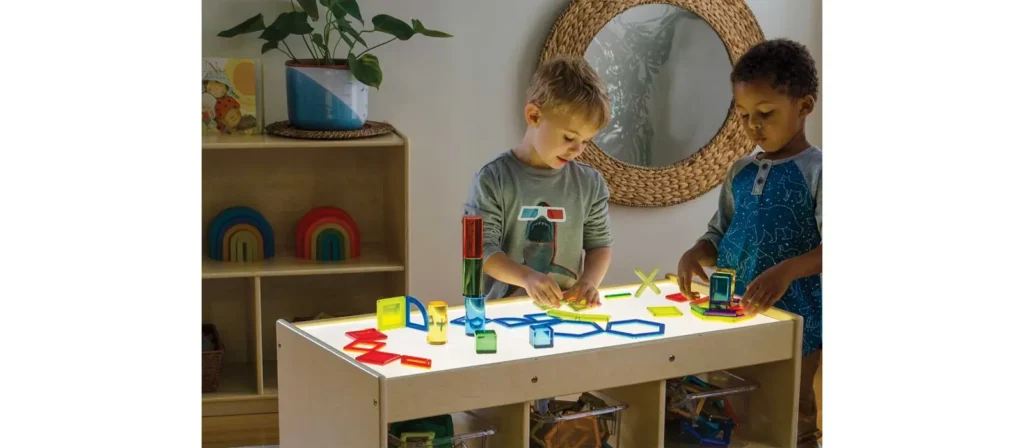
Open-Ended Building and Construction Play
Large foam blocks on the floor. Smaller bongkah kayu on low shelves. Connectors, planks, and loose parts are nearby but not bundled into kits. Children select what fits their current idea.
Younger children often build vertically until it collapses, then repeat. Older children slow down, stabilize bases, and test spans. When both share space, structures become collaborative by necessity; someone holds while someone places.
The key setup choice here is surface flexibility. Open floor space, movable rugs, and low storage shelves that children can access without adult help keep the activity fluid. No one “wins” at construction. Structures are altered, reused, or dismantled without ceremony.
Music, Movement, and Rhythm Activities
Music activities in mixed-age settings work best as stations rather than performances.
A small rug with rhythm instruments. A clear area for movement. A shelf with scarves or ribbons. Children choose how to participate: clapping, listening, moving, or experimenting with sound.
Younger children often focus on repetition. Older children layer rhythm or coordinate movement with others. The activity doesn’t require synchronization.
Musical instrument sets, movement mats, and open storage help keep participation optional rather than compulsory. When music is treated as a space rather than an event, children regulate their own intensity.
Practical Life and Real-World Task Activities
Practical life activities usually run alongside everything else rather than replacing it.
A cleaning station with child-sized tools. A snack prep table. A small gardening area near a window or door. Tasks are visible and available, not scheduled as lessons.
Children contribute differently. One wipes. One pours. One organizes. Another observes and joins later. These activities depend heavily on child-sized furniture, practical life shelves, pouring tools, and storage units that allow independent access.
The work itself doesn’t announce importance. It simply needs doing. Children step into roles naturally because the task exists, not because it’s assigned. Practical life activities often stretch across the day, interrupted and resumed without issue.
Kesimpulan
When they work, it’s rarely because of a single method or material. It’s because the environment, the activities, and the expectations stop assuming that children need to move in sync. Difference becomes ordinary. Unevenness stops being a problem to solve.
What matters most is not whether ages are mixed, but whether the classroom is designed to hold that mix—without constant correction, comparison, or adult intervention. Materials that don’t expire. Activities that don’t require everyone to arrive together. Spaces that tolerate parallel focus.
Mixed-age classrooms demand clarity. About roles. About limits. About what adults will step into—and what they’ll step back from. When that clarity is present, the room does more of the work on its own. That’s usually the signal that a mixed-age classroom has stopped trying to prove itself and has started functioning as intended.